
Best Cold Outreach Tools in 2026: The Lean Stack for B2B Growth
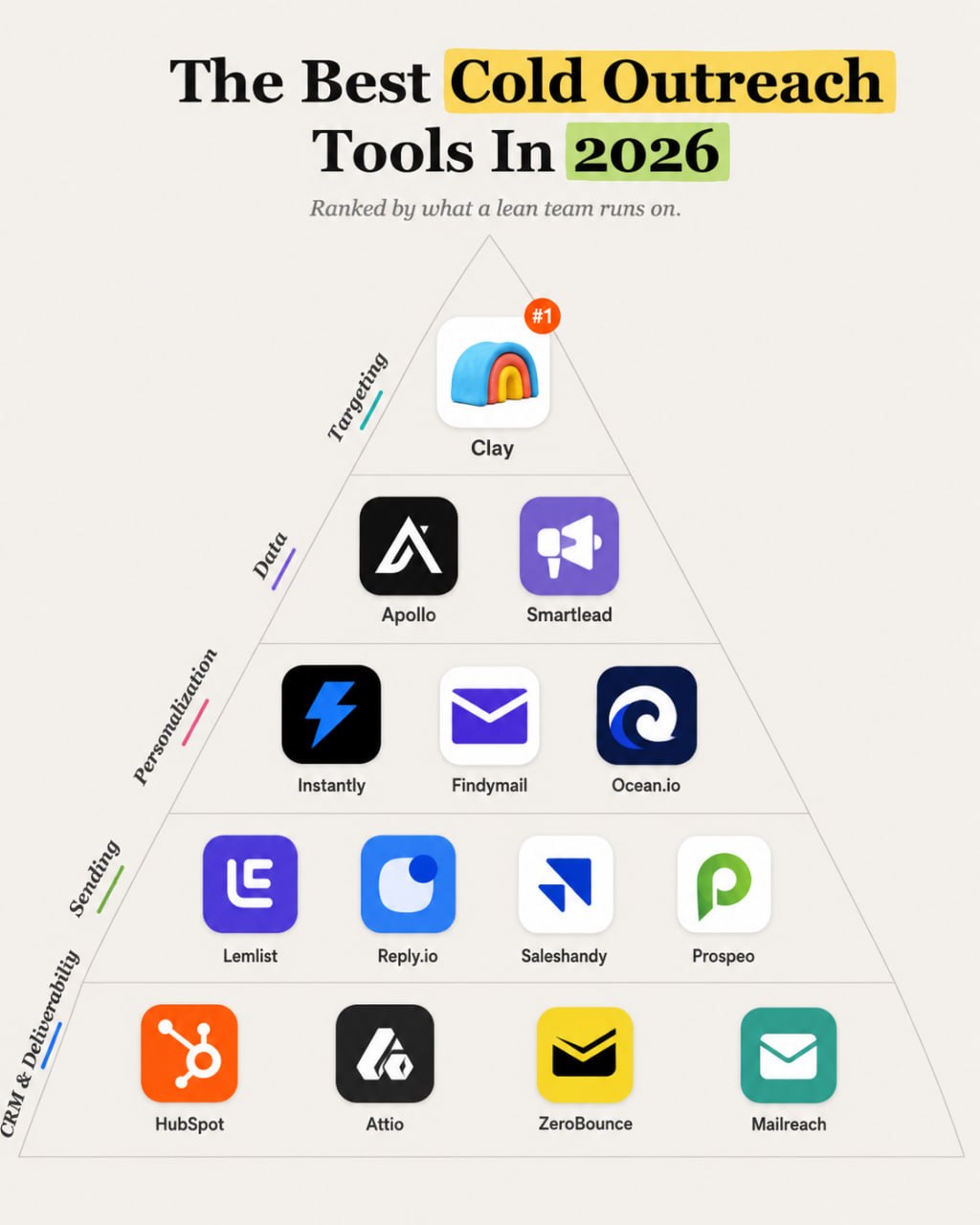
The best cold outreach stack in 2026 is a system: Clay for targeting and enrichment, Apollo or Prospeo for data, Smartlead or Instantly for sending, ZeroBounce for verification, and HubSpot or Attio for CRM follow-up.


Cold outreach works when the team treats it like a system. It fails when the team buys a sender, uploads a messy list, writes one generic message, and hopes volume fixes weak targeting.
Quick answer: Clay is the best advanced workflow layer for targeting, enrichment, and personalization. Apollo is the best practical database plus outreach platform for many lean teams. Smartlead and Instantly are strong cold email sending platforms. ZeroBounce helps protect list quality. HubSpot or Attio should hold the CRM and follow-up process. A lean team should usually start with Clay, Apollo, Smartlead or Instantly, ZeroBounce, and one CRM before adding more data vendors.
Cold outreach includes more than email sending. The full workflow is targeting, prospect data, enrichment, verification, personalization, sequencing, deliverability, replies, CRM handoff, and compliance review.
If your team is still defining the offer and content path, connect this guide with AI marketing automation, AI workflow automation, and AI sales automation. Outreach should support a clear sales motion, not create noise around a fuzzy offer.
Quick verdict
| Need | Best first choice |
|---|---|
| Best overall workflow layer | Clay |
| Best database plus outreach platform | Apollo |
| Best cold email sending platform | Smartlead or Instantly |
| Best email finder and enrichment support | Findymail or Prospeo |
| Best account discovery support | Ocean.io |
| Best sales engagement alternative | Lemlist or Reply.io |
| Best CRM for simple teams | HubSpot |
| Best modern CRM for relationship-heavy teams | Attio |
| Best email verification layer | ZeroBounce |
| Best deliverability support layer | Mailreach |
The best stack is smaller than the vendor category makes it look. Pick one data layer, one workflow layer, one sending layer, one verification layer, and one CRM.
Best cold outreach tools at a glance
Pricing, limits, credits, and deliverability features change often. Check the current pricing page for each vendor before buying.
| Tool | Best for | Category | Starting price | Key strength | Main limitation |
|---|---|---|---|---|---|
| Clay | Advanced prospecting workflows, enrichment, and AI-assisted personalization | Targeting and enrichment | Paid plans and credit-based usage | Flexible workflow builder across data sources | Learning curve and credit management |
| Apollo | Prospect database, enrichment, and sales engagement | Data and outreach platform | Free and paid plans | Large database plus sequencing in one product | Data quality and limits still need review |
| Smartlead | Cold email sending, inbox rotation, and campaign management | Sending | Paid plans | Built for high-volume cold email operations | Requires deliverability discipline |
| Instantly | Cold email sending and lead workflows | Sending | Paid plans | Fast setup for cold email campaigns | Easy to misuse with weak lists |
| Findymail | Email finding and enrichment | Data | Paid and credit-based plans | Helps find and verify business emails | Narrower than full outreach suites |
| Prospeo | Email finding, verification, and prospecting support | Data | Paid and credit-based plans | Useful data support layer | Not a full CRM or strategy layer |
| Ocean.io | Account discovery and lookalike company search | Targeting | Paid plans | Helps find similar accounts | Needs another tool for sending and CRM |
| Lemlist | Sales engagement, personalization, and outreach sequences | Sending and engagement | Paid plans | Outreach workflow and personalization | May overlap with other senders |
| Reply.io | Multichannel sales engagement | Sales engagement | Paid plans | Sales team workflow and channel support | More platform than some lean teams need |
| Saleshandy | Cold email campaigns and outreach management | Sending | Paid plans | Practical cold email workflow | Less flexible than a Clay-led stack |
| HubSpot | CRM and pipeline follow-up | CRM | Free and paid plans | Familiar CRM and sales handoff | Can get expensive as needs grow |
| Attio | Modern CRM for relationship-driven pipelines | CRM | Free and paid plans | Flexible data model and cleaner CRM experience | Requires setup discipline |
| ZeroBounce | Email verification and list quality | Verification | Credit-based and paid options | Helps reduce bad addresses and bounce risk | Verification does not guarantee deliverability |
| Mailreach | Inbox warmup and deliverability support | Deliverability | Paid plans | Helps monitor and support sender reputation | Warmup does not fix bad targeting |
How we evaluated the tools
Cold outreach needs different criteria from normal SaaS comparisons. A tool can look great in a demo and still damage your domain if the workflow is sloppy.
| Criterion | Weight |
|---|---|
| Use-case fit | 25% |
| Data and output quality | 20% |
| Ease of use | 15% |
| Workflow and CRM fit | 15% |
| Price-to-value | 15% |
| Compliance, reliability, and deliverability support | 10% |
The main distinction is tool role. Clay, Findymail, Prospeo, and Ocean.io help with targeting and data. Smartlead, Instantly, Lemlist, Reply.io, and Saleshandy help send and manage outreach. HubSpot and Attio hold the pipeline. ZeroBounce verifies emails. Mailreach supports deliverability.
No tool removes the need for legal review, unsubscribe handling, truthful claims, list relevance, and sender reputation management.
The best cold outreach tools in 2026
Clay: Best for advanced targeting and enrichment
Clay is the best workflow layer when the team needs precise account targeting, multiple enrichment sources, AI-assisted research, and custom personalization. It works like a flexible data table for outbound systems.
It made the list because modern outbound depends on relevance. Clay can help a team combine firmographic filters, website data, job changes, tools used, hiring signals, funding signals, local signals, or custom research steps before writing a message.
Important capabilities include:
- prospect and account enrichment workflows
- integrations with many data providers
- AI-assisted personalization and research
- custom tables and scoring logic
- handoff to sending tools and CRMs
Clay is not the easiest first tool for a beginner. It can also get expensive if the team burns credits without a plan. Choose Clay when your targeting needs logic and depth. Avoid it if you only need a simple prospect list. The closest alternative is Apollo for simpler combined prospecting.
Apollo: Best database plus outreach platform
Apollo combines prospect data, company search, enrichment, sequencing, and sales workflow features. It is a practical first choice when a lean team wants one platform instead of stitching together several tools.
It made the list because many teams need speed. Apollo can help a founder or small sales team find prospects, build lists, enrich contacts, and run basic outreach without designing a full Clay workflow.
Important capabilities include:
- contact and company database
- filters for prospecting
- email sequences
- enrichment and CRM sync options
- sales workflow features
Apollo data still needs verification and relevance checks. Do not assume every contact is current or safe to email. Choose Apollo for a simpler prospecting system. Avoid it if your outbound depends on complex multi-source enrichment. The closest alternative is a Clay plus data-vendor stack.
Smartlead: Best for cold email sending operations
Smartlead is built for cold email sending, campaign management, inbox rotation, deliverability support, and reply handling. It is a strong sending layer when the team already has targeting and list quality under control.
It made the list because cold email sending is operational. The team needs inbox setup, domain safety, sequence controls, reply routing, unsubscribe management, and performance visibility.
Important capabilities include:
- cold email campaign management
- inbox rotation and sender management
- deliverability-oriented controls
- reply handling and campaign analytics
- integrations with outbound workflows
Smartlead does not make a bad list good. Choose it when you need a serious sending layer. Avoid it if you have not defined targeting, verification, compliance, and CRM follow-up. The closest alternative is Instantly.
Instantly: Best fast-start cold email sender
Instantly is a popular cold email platform for teams that want to set up sending, manage campaigns, rotate inboxes, and run outbound programs quickly.
It made the list because speed matters for lean teams. Instantly can help a team move from list to campaign faster than a heavier sales engagement setup.
Important capabilities include:
- cold email campaign setup
- inbox and sending management
- reply and campaign tracking
- lead workflows
- deliverability-related tooling
The risk is also speed. Instantly makes it easy to send before the team has checked the list, domain setup, compliance, and message relevance. Choose it for fast campaign operations. Avoid it if the team equates volume with strategy. The closest alternative is Smartlead.
Findymail: Best email finding support layer
Findymail helps teams find and verify professional email addresses. It can support prospecting workflows where the team already knows the target accounts or people.
It made the list because data gaps slow outbound. A strong email finder can reduce manual work and improve the list before it reaches the sender.
Important capabilities include:
- email finding
- verification support
- prospecting workflows
- enrichment integrations
- credit-based usage
Findymail is not a full outbound platform. Choose it when email discovery is the bottleneck. Avoid it if you need CRM, sequencing, or full account strategy. The closest alternatives are Prospeo, Hunter, and Apollo.
Prospeo: Best prospecting and verification support
Prospeo provides prospecting, email finding, and verification support. It can help teams build cleaner lists before outreach.
It made the list because verification and data quality matter more than raw volume. Prospeo can support a stack where another tool handles enrichment or sending.
Important capabilities include:
- email finder
- domain and company search workflows
- verification support
- API and integration options
- credit-based prospecting
Prospeo is a data layer, not an outreach strategy. Choose it for prospecting and verification support. Avoid it if you need one platform to run the entire outbound process. The closest alternatives are Findymail and Hunter.
Ocean.io: Best for account discovery
Ocean.io helps teams find lookalike companies and discover accounts similar to a target customer profile. That makes it useful when the team knows which accounts convert but needs more of them.
It made the list because cold outreach starts with account fit. Better account discovery can reduce wasted sending and improve reply quality.
Important capabilities include:
- lookalike company discovery
- account search and segmentation
- company data enrichment
- market mapping support
- export and workflow support
Ocean.io does not replace contact enrichment, sending, CRM, or compliance review. Choose it when account discovery is the bottleneck. Avoid it if you already have a clear account list. The closest alternative is account research in Apollo, Clay, or data vendors.
Lemlist: Best for personalized sales engagement
Lemlist supports cold email campaigns, personalization, multichannel outreach, and sales engagement workflows. It can fit teams that want more guidance around outreach sequences and personalization.
It made the list because not every team needs a high-volume sender. Some teams need better sequences, personalization, and follow-up structure.
Important capabilities include:
- email sequence workflows
- personalization features
- multichannel outreach support
- campaign analytics
- CRM integrations
Lemlist can overlap with Smartlead, Instantly, or Reply.io. Choose one primary sending and engagement layer. Choose Lemlist when personalization and sales engagement matter more than raw sending volume. Avoid it if the team already has a sender. The closest alternative is Reply.io.
Reply.io: Best multichannel sales engagement
Reply.io is a sales engagement platform for teams that need email plus broader outbound workflow support. It fits sales teams that want sequencing, tasks, replies, CRM sync, and multichannel touches.
It made the list because some teams need more than cold email. They need a sales process around the outreach.
Important capabilities include:
- email and multichannel sequences
- sales task workflows
- reply handling
- analytics and team controls
- CRM integrations
Reply.io may be more platform than a founder needs for early outbound tests. Choose it for sales-team workflows. Avoid it if you only need a lean cold email sender. The closest alternatives are Lemlist and Saleshandy.
Saleshandy: Best practical cold email campaign manager
Saleshandy helps teams run cold email campaigns, manage sequences, and track performance. It is a practical option for teams that want a focused sender without an overly complex sales engagement suite.
It made the list because many teams need a straightforward cold email platform and do not want to overbuild the stack.
Important capabilities include:
- cold email sequences
- campaign analytics
- inbox and deliverability support features
- reply handling
- team workflows
Saleshandy still needs clean data, verification, and compliance checks. Choose it for straightforward outbound campaigns. Avoid it if your strategy depends on complex enrichment or account scoring. The closest alternatives are Instantly and Smartlead.
HubSpot: Best CRM for simple outbound follow-up
HubSpot is a familiar CRM choice for small and mid-sized teams. It can hold contacts, companies, deals, tasks, emails, forms, and pipeline stages.
It made the list because outbound without CRM follow-up wastes replies. A good campaign should create tasks, route interested prospects, track conversations, and keep the team from losing warm leads.
Important capabilities include:
- contact and company records
- pipeline management
- tasks and sales workflows
- forms and marketing tools
- integrations with outreach tools
HubSpot can get expensive as teams add seats and hubs. Choose it if you want a familiar CRM with room to grow. Avoid it if your team needs a more flexible relationship data model. The closest alternative is Attio.
Attio: Best modern CRM for relationship-heavy outbound
Attio is a modern CRM that can work well for teams that care about flexible data, relationship context, and cleaner pipeline workflows.
It made the list because some outbound teams need a CRM that adapts to their market map instead of forcing a rigid sales process too early.
Important capabilities include:
- flexible company and people records
- lists and pipeline views
- collaboration workflows
- data enrichment and integrations
- relationship-oriented CRM structure
Attio requires setup discipline. Choose it if your team wants a cleaner CRM experience and can define the data model. Avoid it if you need the broad marketing suite that HubSpot provides. The closest alternative is HubSpot.
ZeroBounce: Best email verification layer
ZeroBounce helps verify email addresses and protect list quality before sending. Verification can reduce bounces and catch risky addresses, though it cannot guarantee deliverability.
It made the list because high bounce rates can hurt sender reputation. Verification belongs before the sending tool, not after a campaign already fails.
Important capabilities include:
- email verification
- risk and validity checks
- bulk list cleaning
- API options
- deliverability support features
ZeroBounce does not make irrelevant outreach acceptable. Choose it for list hygiene. Avoid treating verification as permission to email anyone. The closest alternatives are NeverBounce, Bouncer, and other verification tools.
Mailreach: Best deliverability support layer
Mailreach supports email warmup and deliverability monitoring workflows. It can help teams watch sender reputation and inbox placement signals.
It made the list because deliverability matters before the first send. Domains, inboxes, authentication, sending volume, list quality, and complaint rates all affect performance.
Important capabilities include:
- inbox warmup support
- deliverability monitoring
- sender reputation support
- campaign readiness checks
- reporting around inbox placement
Warmup does not fix bad targeting, misleading copy, poor consent logic, or high complaints. Choose Mailreach as a supporting layer. Avoid using it as a shield for spammy outreach. The closest alternatives are other warmup and deliverability monitoring tools.
Recommended stacks by team type
Solo operator
Use Apollo, Instantly or Smartlead, ZeroBounce, and HubSpot free CRM. This keeps the stack simple: find prospects, verify addresses, send carefully, and track replies.
Skip Clay until you need richer enrichment or personalization.
Lean startup
Use Clay, Apollo or Prospeo, Smartlead, ZeroBounce, and Attio or HubSpot. Clay handles targeting and enrichment. Apollo or Prospeo supports data. Smartlead handles sending. The CRM protects follow-up.
Do not add Lemlist, Reply.io, and Saleshandy on top of Smartlead unless you have a clear reason.
Agency
Use Clay, multiple data providers, Smartlead or Instantly, ZeroBounce, Mailreach, and HubSpot. Agencies need repeatable workflows, client separation, deliverability discipline, and reporting.
Add Ocean.io when clients need account discovery or lookalike company targeting.
Technical outbound team
Use Clay, APIs, Prospeo or Findymail, Smartlead, Attio, ZeroBounce, and custom webhooks. This stack lets the team build research, scoring, routing, and CRM updates around the exact market.
Make compliance review part of the workflow before sending.
Sales-led team
Use Apollo or Clay for data, Reply.io or Lemlist for sales engagement, HubSpot for CRM, and ZeroBounce for verification. This fits teams where SDR workflow and pipeline handoff matter more than pure email volume.
How to choose the right cold outreach tool
Start with the sales motion:
| Buying question | What to decide |
|---|---|
| Team size | Founder-led outbound needs simplicity. SDR teams need handoff, permissions, templates, and reporting. |
| Targeting depth | Broad prospecting can start in Apollo. Complex targeting may need Clay. |
| Data source | Decide whether the team needs contacts, accounts, lookalikes, enrichment, or verification. |
| Sending volume | Higher volume requires stronger domain setup, inbox management, and deliverability monitoring. |
| CRM fit | Replies need owner, stage, next task, and follow-up history. |
| Compliance | Review CAN-SPAM, GDPR, local privacy rules, unsubscribe handling, and truthful claims. |
| Budget | Watch credits, inbox costs, enrichment costs, CRM seats, and sending platform fees. |
| Learning curve | The stack fails if the owner cannot maintain it. |
| Switching costs | Data models, sequences, warmed domains, and CRM history become hard to migrate. |
The practical workflow looks like this:
- Define the narrow ICP and offer.
- Build the account list.
- Enrich contacts and verify emails.
- Score and segment prospects.
- Write relevant messages with real business context.
- Set sending limits and unsubscribe handling.
- Route replies into the CRM.
- Review complaints, bounces, meetings, and revenue, not only open rates.
Compliance and deliverability notes
Cold outreach has real risk. In the United States, the FTC's CAN-SPAM guidance requires accurate header information, non-deceptive subject lines, ad identification where required, a valid physical postal address, and a clear opt-out process. Other countries have different privacy and consent rules.
Google and Yahoo sender requirements also pushed teams toward better authentication, lower complaint rates, easier unsubscribe, and stronger domain hygiene. That means SPF, DKIM, DMARC, list quality, and complaint monitoring are no longer optional for serious sending.
AI personalization can create reputational risk. Do not let a model invent a reason for outreach, pretend to know someone, cite false company details, or overstate proof. Use AI to research and draft, then verify before sending.
Tools we considered but did not rank
Hunter is credible for email finding and outreach, but it overlaps with Apollo, Findymail, and Prospeo for this stack.
Snov.io is a capable prospecting and outreach platform, but the recommended stack already covers data and sending with stronger current fit for the mapped workflow.
Woodpecker is useful for cold email campaigns, especially for agencies and B2B teams, but it overlaps with Smartlead, Instantly, Saleshandy, and Lemlist.
ZoomInfo is a major B2B data provider, but it is often sales-led and expensive for lean teams.
Outreach and Salesloft are strong enterprise sales engagement platforms, but they are usually more than a lean team needs for early outbound.
Final recommendation
Most lean B2B growth teams should start with this stack:
- Clay for targeting, enrichment, scoring, and personalization
- Apollo or Prospeo for prospect data
- Smartlead or Instantly for sending
- ZeroBounce for verification
- HubSpot or Attio for CRM follow-up
Add Mailreach when deliverability becomes a serious operational concern. Add Ocean.io when account discovery is the bottleneck. Add Lemlist or Reply.io when the team needs more sales engagement structure.
The best default is Clay plus Smartlead plus a CRM if you can handle the workflow. The simpler default is Apollo plus Instantly plus HubSpot if you need speed. In both cases, list quality, compliance, and follow-up matter more than sending volume.
Sources to check before buying
- FTC CAN-SPAM compliance guide
- Google email sender guidelines
- Yahoo sender best practices
- Clay
- Apollo
- Smartlead
- Instantly
- ZeroBounce
- Mailreach
Lead follow-up next step
Stop letting leads sit without a next action.
Business Boomer can install lead capture, first-response drafts, quote follow-up reminders, and a simple owner handoff.
FAQ
Quick answers about this guide and how to put the idea into practice.
What is the best cold outreach tool in 2026?
Clay is the best workflow layer for advanced B2B targeting, enrichment, and personalization. Smartlead and Instantly are strong sending platforms. Apollo is useful when a team wants prospect data plus sequencing in one platform.
What should a lean cold outreach stack include?
A lean stack should include one prospect data source, one enrichment and personalization workflow, one email verification tool, one sending platform, and one CRM or pipeline system.
Is cold email still legal in 2026?
Cold email rules depend on the country and recipient. U.S. senders must follow CAN-SPAM requirements, and teams contacting people in the EU or UK need to review GDPR and local privacy rules before sending.
Should a small team use Clay or Apollo?
Use Apollo if you want a simpler prospecting database and outreach platform. Use Clay if you need richer workflows, multiple data sources, custom enrichment, AI-assisted personalization, and more control.
What is the biggest cold outreach mistake?
The biggest mistake is sending to a weak list from a new domain without verification, relevance, consent logic, deliverability controls, unsubscribe handling, and CRM follow-up.