
Best Product Marketing Tools in 2026: Research, Messaging, Launch, and Analytics
The best product marketing stack in 2026 starts with customer research, then turns that insight into positioning, messaging, launch assets, adoption loops, and analytics. Dovetail, Wynter, UserTesting, Productboard, ChatGPT, Claude, Notion, Figma, Canva, Pendo, Mixpanel, and Amplitude each support a different layer.


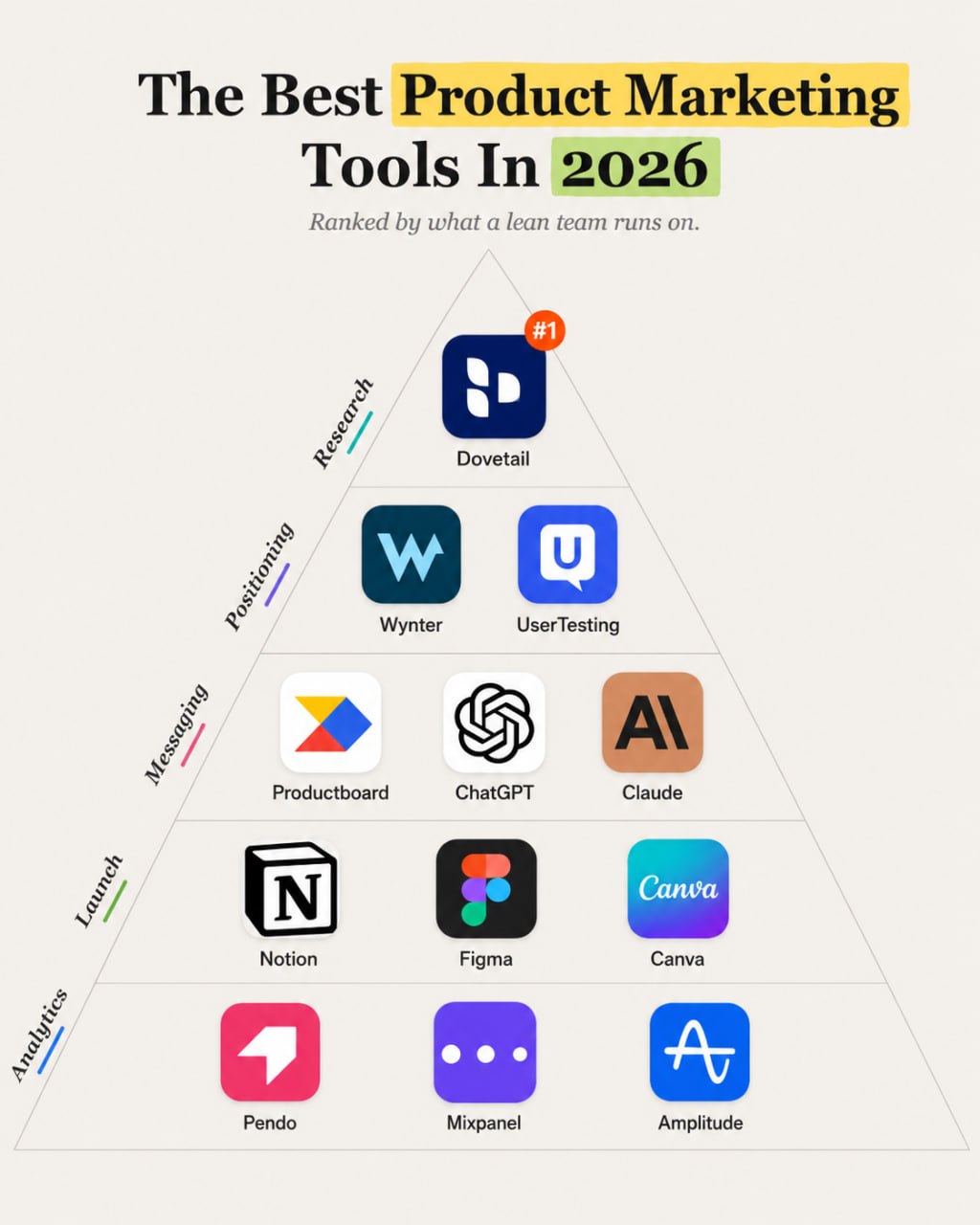
Product marketing breaks when teams write messaging before they understand the buyer. The right stack helps you collect customer evidence, test positioning, turn insights into launch assets, and measure adoption.
Quick answer: Lean teams should start with Dovetail or a simpler research repository, ChatGPT or Claude for messaging drafts, Notion for launch planning, Figma or Canva for assets, and Mixpanel, Amplitude, or Pendo when adoption data matters.
This guide ranks tools by workflow fit, output quality, ease of use, integrations, value, and reliability. Pricing changes often, so check current vendor pricing pages before you buy.
If you are building the broader stack, compare this guide with AI SEO tools, content marketing tools, and startup growth tools.
Quick verdict
| Need | Best first choice |
|---|---|
| Best overall research hub | Dovetail |
| Best message testing | Wynter |
| Best usability and customer feedback | UserTesting |
| Best roadmap-to-market bridge | Productboard |
| Best messaging assistant | ChatGPT or Claude |
| Best launch planning layer | Notion |
| Best launch asset layer | Figma or Canva |
| Best product adoption layer | Pendo |
| Best product analytics | Mixpanel or Amplitude |
Best tools at a glance
| Tool | Best for | Category | Starting price | Key strength | Main limitation |
|---|---|---|---|---|---|
| Dovetail | customer research repositories | Research | Paid plans | Centralizes interviews and insights | Needs research discipline |
| Wynter | B2B message testing | Validation | Paid plans | Tests messaging with target audiences | Narrower than general research tools |
| UserTesting | customer feedback and usability research | Research | Contact sales / paid plans | Fast customer feedback workflows | Can be expensive for casual use |
| Productboard | product feedback and prioritization | Product management | Paid plans | Connects feedback to roadmap decisions | Not a copywriting tool |
| ChatGPT | messaging drafts and launch copy | AI assistant | Free and paid plans | Flexible writing and synthesis | Needs evidence and review |
| Claude | positioning cleanup and long-form review | AI assistant | Free and paid plans | Strong editorial work | Not a research platform |
| Notion | launch plans and PMM docs | Planning | Free and paid plans | Flexible launch source of truth | Can sprawl without ownership |
| Figma | product visuals and design collaboration | Design | Free and paid plans | Strong for product screenshots and launch assets | Learning curve for non-designers |
| Canva | fast launch graphics | Design | Free and paid plans | Easy asset production | Less control than Figma |
| Pendo | in-app adoption and guidance | Product adoption | Contact sales / paid plans | Connects product behavior to guidance | Too much for many early teams |
| Mixpanel | product analytics | Analytics | Free and paid plans | Strong event analysis | Requires clean tracking plan |
| Amplitude | product analytics | Analytics | Free and paid plans | Strong behavioral analytics | Setup quality determines value |
How we evaluated the tools
We evaluated each tool as part of a real operating workflow, not as an isolated feature list.
| Criterion | Weight |
|---|---|
| Use-case fit | 25% |
| Capability and output quality | 20% |
| Ease of use | 15% |
| Integrations and workflow fit | 15% |
| Price-to-value | 15% |
| Scalability and reliability | 10% |
A complete platform can own several workflow layers. A specialist tool should earn its place by solving one painful job better than the default stack. Supporting tools belong lower in the stack unless the workflow depends on them every week.
The best product marketing tools in 2026
Dovetail: Best for best product marketing research hub
Dovetail helps teams store interviews, tag themes, pull quotes, and turn qualitative research into usable insight. Choose it when research is frequent enough to need a real repository. Avoid it if the team has only a handful of notes and no research cadence. Closest alternative: Condens or Notion for a lighter setup.
Key capabilities usually include setup, workflow ownership, integrations, review, and reporting. The best choice depends on team size, existing stack, data quality, and budget.
Wynter: Best for best message testing tool
Wynter helps B2B teams test landing page copy, positioning, and message clarity with target audiences. Choose it when the risk is weak positioning, unclear value props, or homepage confusion. Avoid it if the team has not written a clear hypothesis. Closest alternative: customer interviews plus sales-call review.
Key capabilities usually include setup, workflow ownership, integrations, review, and reporting. The best choice depends on team size, existing stack, data quality, and budget.
UserTesting: Best for best feedback and usability research tool
UserTesting helps teams collect feedback on product flows, messaging, prototypes, and buying journeys. Choose it when you need faster user feedback than your own network can provide. Avoid it when the team cannot act on the findings. Closest alternative: Maze for some testing workflows.
Key capabilities usually include setup, workflow ownership, integrations, review, and reporting. The best choice depends on team size, existing stack, data quality, and budget.
Productboard: Best for best roadmap-to-market bridge
Productboard helps product teams collect feedback, prioritize needs, and connect customer evidence to roadmap decisions. Product marketers can use it to understand why a feature matters before building a launch. Avoid using it as a launch calendar. Closest alternative: Aha! or ProductPlan for some teams.
Key capabilities usually include setup, workflow ownership, integrations, review, and reporting. The best choice depends on team size, existing stack, data quality, and budget.
ChatGPT and Claude: Best for best messaging assistants
Use ChatGPT and Claude to turn research into positioning options, product storylines, launch emails, sales enablement drafts, comparison pages, and FAQ copy. They need source material. Avoid asking them to invent customer pain, feature value, or competitive claims. Closest alternative: a structured human copywriting workflow.
Key capabilities usually include setup, workflow ownership, integrations, review, and reporting. The best choice depends on team size, existing stack, data quality, and budget.
Notion: Best for best launch planning workspace
Notion works well for launch briefs, positioning docs, asset checklists, owner tracking, and post-launch retros. Choose it when you need one shared workspace. Avoid it if nobody will maintain the launch template. Closest alternative: Asana, Airtable, or Linear depending on team culture.
Key capabilities usually include setup, workflow ownership, integrations, review, and reporting. The best choice depends on team size, existing stack, data quality, and budget.
Figma and Canva: Best for best launch asset tools
Figma is better for product visuals, website sections, design systems, and reusable launch assets. Canva is better for fast social graphics and simple non-designer production. Choose based on asset complexity. Avoid forcing all creative work into one tool if the team has different skill levels.
Key capabilities usually include setup, workflow ownership, integrations, review, and reporting. The best choice depends on team size, existing stack, data quality, and budget.
Pendo, Mixpanel, and Amplitude: Best for best adoption and analytics layer
Pendo helps with in-app guidance and adoption. Mixpanel and Amplitude help teams understand behavior, activation, retention, and feature usage. Choose them when product usage data informs messaging and lifecycle work. Avoid buying analytics without an event tracking plan.
Key capabilities usually include setup, workflow ownership, integrations, review, and reporting. The best choice depends on team size, existing stack, data quality, and budget.
Recommended stacks by team type
Solo PMM
Use Notion, ChatGPT or Claude, Canva, customer calls. This keeps the stack focused while giving each workflow layer a clear owner.
Lean startup
Use Dovetail, ChatGPT, Notion, Figma, Mixpanel. This keeps the stack focused while giving each workflow layer a clear owner.
B2B SaaS team
Use Dovetail, Wynter, Productboard, Figma, Amplitude. This keeps the stack focused while giving each workflow layer a clear owner.
Enterprise PMM team
Use Dovetail, UserTesting, Productboard, Pendo, Amplitude. This keeps the stack focused while giving each workflow layer a clear owner.
Non-technical team
Use Notion, Canva, ChatGPT, lightweight survey and interview tools. This keeps the stack focused while giving each workflow layer a clear owner.
How to choose the right tool
Start with the workflow. A small team should not buy a platform because it looks impressive in a comparison table. Ask what job breaks today: research, creative production, conversion, analytics, lifecycle, support, automation, or reporting.
Team size matters. A solo operator needs fewer tools and more defaults. A startup with engineers can handle deeper instrumentation. An agency needs repeatable workflows across clients. A mid-market team needs governance, permissions, and reporting.
Budget matters too. Free and entry-level plans can cover early workflows, but paid plans become worthwhile when the tool saves labor, reduces mistakes, or improves decisions. Switching costs rise when tools hold customer data, content libraries, automations, analytics events, or payment history.
Check integrations before buying. A tool that does not connect to your CRM, website, analytics, email platform, or data warehouse may create another manual process. Also check data ownership, export options, security posture, and approval controls before connecting sensitive workflows.
Tools we considered but did not rank
- Airtable because it is useful but less PMM-specific.
- Asana because it manages tasks more than messaging quality.
- Miro because it helps workshops but not the whole workflow.
- Sprig because it fits product feedback but overlaps with this stack for many teams.
Final recommendation
Start with research, not copy. Use Dovetail or a lighter research hub, ChatGPT or Claude for messaging drafts, Notion for launch planning, Figma or Canva for assets, and Mixpanel, Amplitude, or Pendo when adoption data guides the launch.
The right stack should make the workflow easier to run next week. If a tool creates more meetings, more dashboards, or more cleanup than decisions, it belongs on the waitlist.
AI automation next step
Find the workflow worth fixing first.
Use the Free 30-Minute AI Consultation to map where leads, reviews, content, or follow-ups are slipping and choose the smallest useful next step.
Sources to check before purchase
- Official product websites and pricing pages for the tools above
- Current documentation for integrations, data handling, API access, and usage limits
- Recent customer reviews on G2, Capterra, Trustpilot, Reddit, or category-specific communities
Ready to build a practical AI growth stack?
AI Business Boomer helps lean teams turn scattered tools into working systems. Book a workflow audit and we will map the stack around your actual bottleneck.
FAQ
Quick answers about this guide and how to put the idea into practice.
What is the best product marketing tool in 2026?
Dovetail is the best research hub for many product marketing teams, but the best stack also needs messaging, planning, launch assets, and analytics.
Do product marketers need product analytics tools?
Yes, when adoption, activation, retention, and feature usage affect messaging and launches. Early teams can start with simpler analytics before buying advanced tools.
Should PMMs use ChatGPT or Claude?
Use either for synthesis, messaging drafts, launch copy, enablement, and editing. Provide source material and review claims manually.
What tool helps with positioning validation?
Wynter is a strong B2B message testing option. Customer interviews and sales-call review are lower-cost alternatives.
What should a lean PMM stack include?
Use a research hub, an AI writing assistant, a planning workspace, a design tool, and product analytics when usage data matters.