
Best Startup Growth Tools in 2026: Analytics, Lifecycle, CRM, Experiments, and Automation
The best startup growth stack in 2026 starts with product analytics, a CRM, lifecycle messaging, customer feedback, experiments, behavior analytics, and automation. PostHog, Mixpanel, HubSpot, Amplitude, Customer.io, Intercom, Attio, VWO, Hotjar, Microsoft Clarity, Zapier, Make, and n8n each fit a different layer.


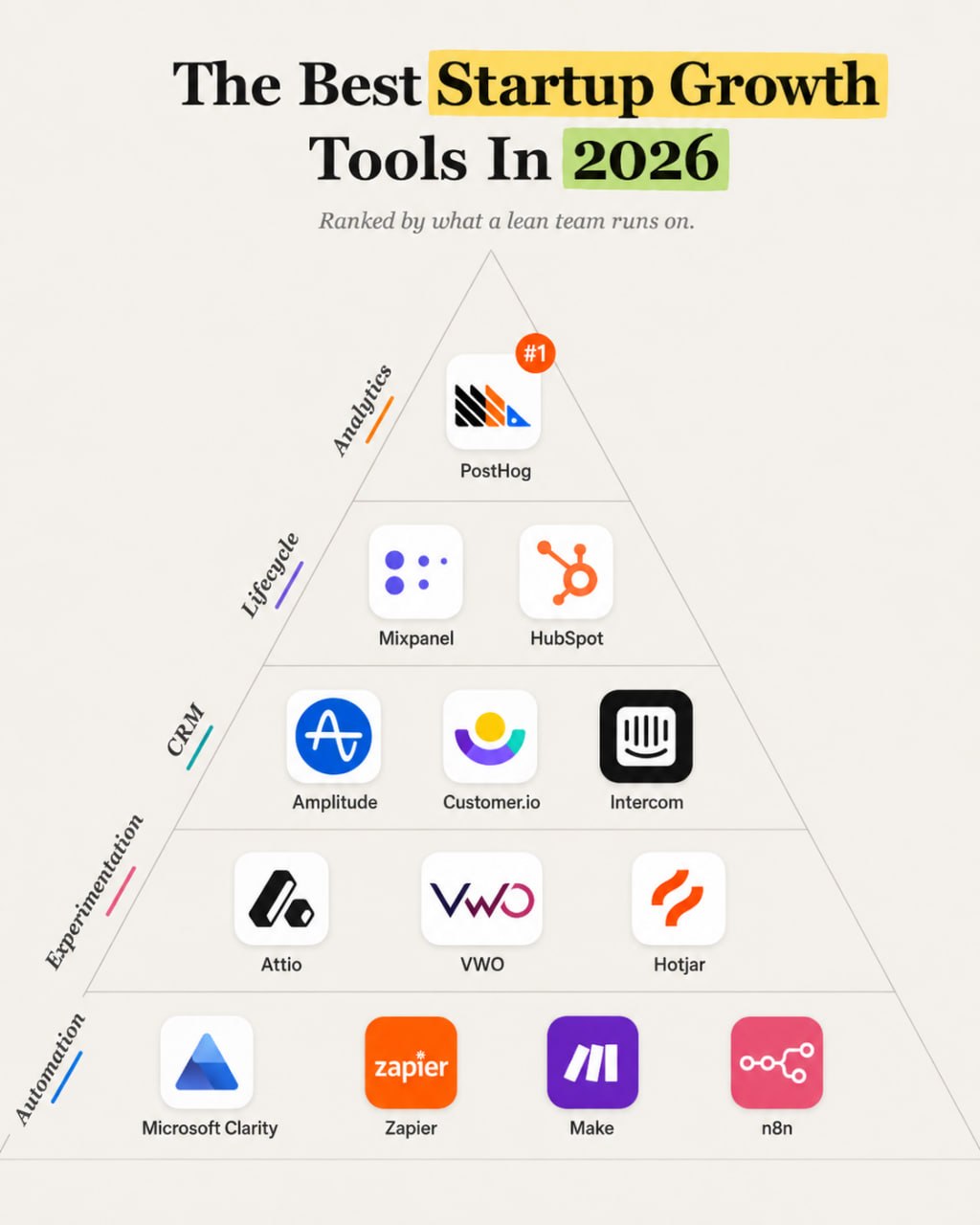
Startup growth tools should answer one question: where does the funnel actually break? Random tools create dashboards, campaigns, and automations without changing activation, retention, or revenue.
Quick answer: Most startups should start with PostHog or Mixpanel, HubSpot or Attio, Customer.io when lifecycle messaging matters, Intercom for support and customer feedback, Clarity or Hotjar for behavior review, and one automation layer such as Zapier, Make, or n8n.
This guide ranks tools by workflow fit, output quality, ease of use, integrations, value, and reliability. Pricing changes often, so check current vendor pricing pages before you buy.
If you are building the broader stack, compare this guide with AI SEO tools, content marketing tools, and startup growth tools.
Quick verdict
| Need | Best first choice |
|---|---|
| Best overall startup growth platform | PostHog |
| Best product analytics alternative | Mixpanel |
| Best broad CRM for startups | HubSpot |
| Best modern CRM for lean teams | Attio |
| Best lifecycle messaging | Customer.io |
| Best support and feedback loop | Intercom |
| Best enterprise product analytics | Amplitude |
| Best experiments | VWO |
| Best behavior analytics | Hotjar or Microsoft Clarity |
| Best automation layer | Zapier, Make, or n8n |
Best tools at a glance
| Tool | Best for | Category | Starting price | Key strength | Main limitation |
|---|---|---|---|---|---|
| PostHog | product analytics and growth engineering | Analytics | Free and paid plans | Combines analytics, flags, session replay, and experiments | Needs thoughtful event design |
| Mixpanel | event-based product analytics | Analytics | Free and paid plans | Strong funnel and cohort analysis | Tracking quality determines value |
| HubSpot | CRM and lifecycle sales/marketing workflows | CRM | Free and paid plans | Broad CRM ecosystem | Can become complex or expensive |
| Amplitude | advanced product analytics | Analytics | Free and paid plans | Strong behavioral analysis | More than some early teams need |
| Customer.io | lifecycle messaging | Messaging | Paid plans | Flexible event-triggered messaging | Requires clean data and messaging strategy |
| Intercom | support, chat, and customer feedback | Support | Paid plans | Connects support to growth signals | Costs can rise with usage |
| Attio | modern flexible CRM | CRM | Free and paid plans | Clean relationship data model | You still design the sales process |
| VWO | experimentation and testing | Experimentation | Paid plans | Structured A/B testing | Needs enough traffic |
| Hotjar | heatmaps and session behavior | Behavior analytics | Free and paid plans | Qualitative behavior review | Not a full analytics system |
| Microsoft Clarity | free session replay and heatmaps | Behavior analytics | Free | Low-cost behavior visibility | Limited compared with paid suites |
| Zapier | simple app automation | Automation | Free and paid plans | Easy app connections | Can get brittle with complex logic |
| Make | visual workflow automation | Automation | Free and paid plans | Good multi-step workflows | Needs ownership |
| n8n | technical workflow automation | Automation | Free self-hosted and paid cloud options | Control and flexibility | Higher setup burden |
How we evaluated the tools
We evaluated each tool as part of a real operating workflow, not as an isolated feature list.
| Criterion | Weight |
|---|---|
| Use-case fit | 25% |
| Capability and output quality | 20% |
| Ease of use | 15% |
| Integrations and workflow fit | 15% |
| Price-to-value | 15% |
| Scalability and reliability | 10% |
A complete platform can own several workflow layers. A specialist tool should earn its place by solving one painful job better than the default stack. Supporting tools belong lower in the stack unless the workflow depends on them every week.
The best startup growth tools in 2026
PostHog: Best for best default startup growth platform
PostHog combines product analytics, funnels, feature flags, session replay, experiments, surveys, and more in one developer-friendly stack. Choose it when growth and product teams need shared truth. Avoid it if nobody owns instrumentation. Closest alternative: Mixpanel plus separate tools.
Key capabilities usually include setup, workflow ownership, integrations, review, and reporting. The best choice depends on team size, existing stack, data quality, and budget.
Mixpanel and Amplitude: Best for best product analytics choices
Mixpanel is strong for funnels, cohorts, retention, and event analysis. Amplitude is strong for deeper behavioral analytics and larger product teams. Choose one analytics source of truth. Avoid running multiple product analytics tools without a tracking plan. Closest alternative: PostHog.
Key capabilities usually include setup, workflow ownership, integrations, review, and reporting. The best choice depends on team size, existing stack, data quality, and budget.
HubSpot and Attio: Best for best CRM layer
HubSpot gives startups a broad CRM, marketing, sales, and support ecosystem. Attio gives modern flexible relationship management for lean teams. Choose HubSpot when the team wants a mature CRM suite. Choose Attio when the team wants a cleaner lightweight CRM. Avoid buying CRM features before defining stages and owners.
Key capabilities usually include setup, workflow ownership, integrations, review, and reporting. The best choice depends on team size, existing stack, data quality, and budget.
Customer.io: Best for best lifecycle messaging layer
Customer.io helps teams send event-triggered onboarding, activation, retention, and win-back messages. Choose it when user behavior should drive email, push, or SMS workflows. Avoid it if event data is messy. Closest alternative: HubSpot workflows or Braze for larger teams.
Key capabilities usually include setup, workflow ownership, integrations, review, and reporting. The best choice depends on team size, existing stack, data quality, and budget.
Intercom: Best for best support-to-growth feedback loop
Intercom gives startups chat, support, knowledge base, and customer conversation workflows. Choose it when support conversations reveal activation blockers and sales objections. Avoid it when a simple shared inbox is enough. Closest alternative: Zendesk or Help Scout.
Key capabilities usually include setup, workflow ownership, integrations, review, and reporting. The best choice depends on team size, existing stack, data quality, and budget.
VWO, Hotjar, and Microsoft Clarity: Best for best experiment and behavior review tools
VWO fits teams with enough traffic to run tests. Hotjar and Clarity help teams watch behavior and find confusion points. Choose Clarity as a free starting point, Hotjar for more research features, and VWO for structured experiments. Avoid A/B testing without enough traffic.
Key capabilities usually include setup, workflow ownership, integrations, review, and reporting. The best choice depends on team size, existing stack, data quality, and budget.
Zapier, Make, and n8n: Best for best automation layer
Zapier is easiest, Make is stronger for visual multi-step flows, and n8n gives technical teams control. Use one to connect CRM updates, lead routing, enrichment, alerts, and reporting. Avoid automating broken processes. Closest alternative: native automations inside HubSpot or Customer.io.
Key capabilities usually include setup, workflow ownership, integrations, review, and reporting. The best choice depends on team size, existing stack, data quality, and budget.
Recommended stacks by team type
Solo founder
Use PostHog, Attio, Clarity, Zapier. This keeps the stack focused while giving each workflow layer a clear owner.
Lean SaaS startup
Use PostHog, Customer.io, Intercom, Attio, Make. This keeps the stack focused while giving each workflow layer a clear owner.
Sales-led startup
Use HubSpot, Intercom, PostHog, Looker Studio. This keeps the stack focused while giving each workflow layer a clear owner.
Product-led startup
Use PostHog or Mixpanel, Customer.io, Clarity, VWO when traffic supports it. This keeps the stack focused while giving each workflow layer a clear owner.
Technical team
Use PostHog, n8n, Customer.io, warehouse or BI layer. This keeps the stack focused while giving each workflow layer a clear owner.
How to choose the right tool
Start with the workflow. A small team should not buy a platform because it looks impressive in a comparison table. Ask what job breaks today: research, creative production, conversion, analytics, lifecycle, support, automation, or reporting.
Team size matters. A solo operator needs fewer tools and more defaults. A startup with engineers can handle deeper instrumentation. An agency needs repeatable workflows across clients. A mid-market team needs governance, permissions, and reporting.
Budget matters too. Free and entry-level plans can cover early workflows, but paid plans become worthwhile when the tool saves labor, reduces mistakes, or improves decisions. Switching costs rise when tools hold customer data, content libraries, automations, analytics events, or payment history.
Check integrations before buying. A tool that does not connect to your CRM, website, analytics, email platform, or data warehouse may create another manual process. Also check data ownership, export options, security posture, and approval controls before connecting sensitive workflows.
Tools we considered but did not rank
- Segment because it is useful infrastructure but too heavy for many lean teams.
- Braze because it skews larger lifecycle teams.
- Optimizely because it fits mature experimentation programs.
- Salesforce because it is often too heavy for early startups.
Final recommendation
Start with instrumentation. Use PostHog as the default growth analytics layer, Attio or HubSpot for CRM, Customer.io when lifecycle matters, Intercom for support feedback, Clarity or Hotjar for behavior review, and one automation tool.
The right stack should make the workflow easier to run next week. If a tool creates more meetings, more dashboards, or more cleanup than decisions, it belongs on the waitlist.
Sources to check before purchase
- Official product websites and pricing pages for the tools above
- Current documentation for integrations, data handling, API access, and usage limits
- Recent customer reviews on G2, Capterra, Trustpilot, Reddit, or category-specific communities
Ready to build a practical AI growth stack?
AI Business Boomer helps lean teams turn scattered tools into working systems. Book a workflow audit and we will map the stack around your actual bottleneck.
Keep building the system
Recommended next Business Boomer guides
These links are selected by topic and search intent so this guide connects to the most relevant service pages, industry pages, and supporting blog posts.
Service and setup pages
Use these when you are ready to turn the idea into an implementation path.
Industry-specific pages
See how the same workflow changes for specific business types.
Related blog posts
Read the connected guides that support this topic cluster.
Related AI automation guides
Keep going with the connected Business Boomer guides in this automation cluster.
Best invoicing automation tools for small business
A comparison of QuickBooks, FreshBooks, Stripe Billing, Wave, Jobber, Housecall Pro, Zapier, and Make.
Best AI automations for contractors
Field notes, estimate follow-up, scheduling, internal handoffs, and admin workflows.
AI automation services for local small business
Planning examples for broader automation. Compare current managed calls and reviews on the Services page; confirm other work in a separate scope.
AI automation for local service businesses
Practical lead, scheduling, review, CRM, invoice, and admin automation for plumbers, HVAC companies, roofers, landscapers, cleaners, contractors, and other local operators.
FAQ
Quick answers about this guide and how to put the idea into practice.
What is the best startup growth tool in 2026?
PostHog is the best default for many technical startups because it combines product analytics, session replay, feature flags, and experiments.
Should startups use HubSpot or Attio?
Use HubSpot when you want a broad CRM ecosystem. Use Attio when you want a lighter modern CRM with flexible relationship data.
When should a startup add Customer.io?
Add Customer.io when behavior-triggered onboarding, activation, retention, and lifecycle messages become important.
Do startups need experimentation tools?
Only when they have enough traffic or users to learn from tests. Before that, use qualitative feedback and analytics.
What is the lean startup growth stack?
Use PostHog, Attio or HubSpot, Intercom or a support inbox, Clarity, and one automation tool.
Stop letting leads sit without a next action.
Business Boomer can install lead capture, first-response drafts, quote follow-up reminders, and a simple owner handoff.
See Lead Follow-Up Automation