
Best Paid Advertising Tools in 2026: The Lean Stack for Growth Teams
The best paid advertising stack in 2026 starts with the ad platforms where your buyers actually are, a practical creative workflow, landing page testing, and honest attribution. Google Ads and Meta Ads remain the default platform layer for many teams, while tools like AdCreative.ai, Pencil, Unbounce, Webflow, Triple Whale, Northbeam, and Hyros fill narrower jobs.


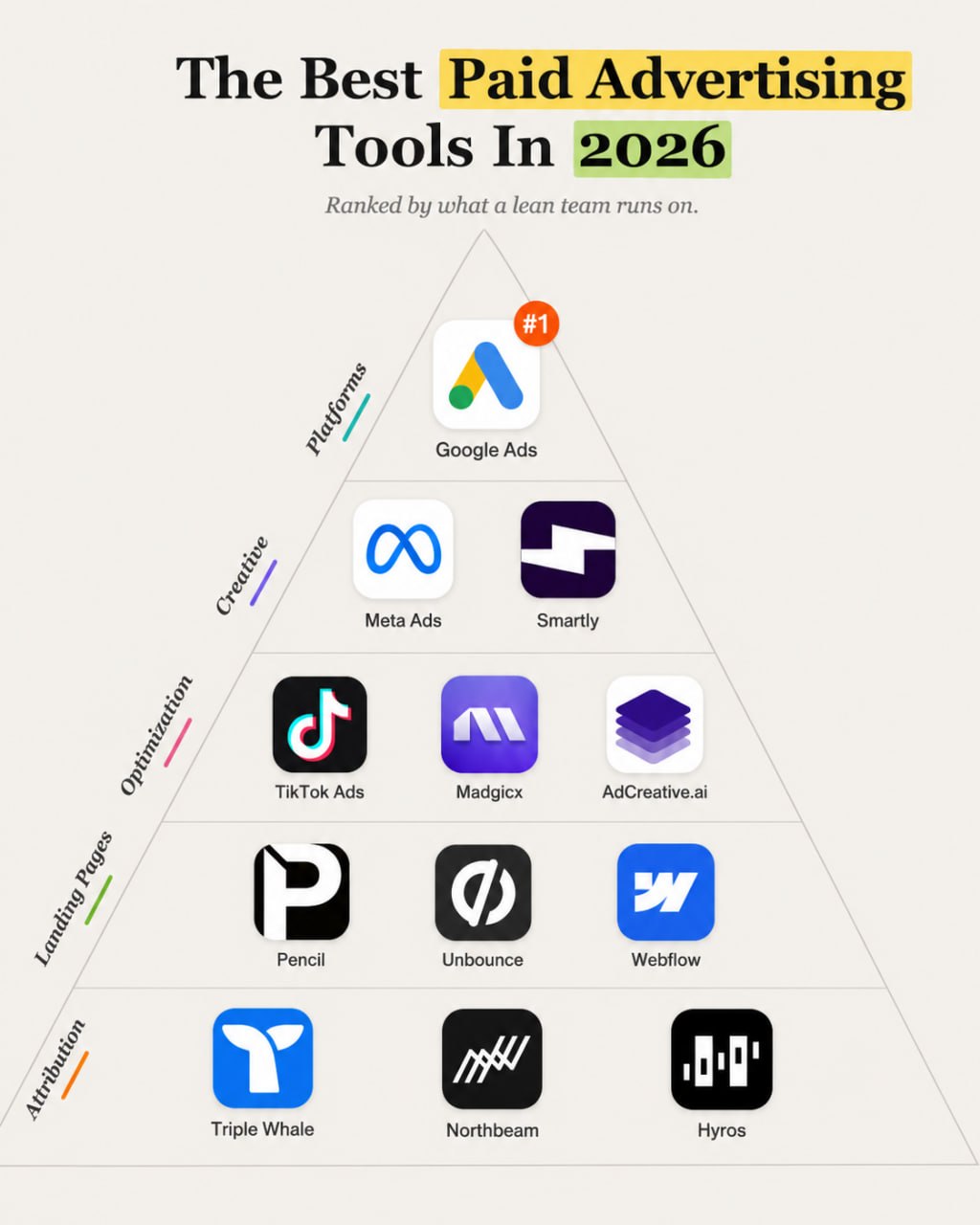
Paid advertising tools do not fix weak offers, bad landing pages, or unclear tracking. They help you buy attention, test creative, route traffic, and understand performance.
Quick answer: Most lean teams should start with Google Ads or Meta Ads, use native platform reporting, build landing pages in Webflow or Unbounce, and add creative or attribution tools only after spend and complexity justify them.
This guide ranks tools by workflow fit, output quality, ease of use, integrations, value, and reliability. Pricing changes often, so check current vendor pricing pages before you buy.
If you are building the broader stack, compare this guide with AI SEO tools, content marketing tools, and startup growth tools.
Quick verdict
| Need | Best first choice |
|---|---|
| Best overall platform layer | Google Ads and Meta Ads |
| Best short-form/social channel | TikTok Ads |
| Best enterprise campaign management | Smartly |
| Best AI ad creative support | AdCreative.ai or Pencil |
| Best landing page testing | Unbounce |
| Best flexible landing pages | Webflow |
| Best ecommerce attribution | Triple Whale or Northbeam |
| Best high-ticket attribution workflows | Hyros |
Best tools at a glance
| Tool | Best for | Category | Starting price | Key strength | Main limitation |
|---|---|---|---|---|---|
| Google Ads | search, shopping, YouTube, and demand capture | Ad platform | Usage-based | High-intent demand capture | Competition and tracking setup matter |
| Meta Ads | paid social acquisition and retargeting | Ad platform | Usage-based | Large social reach and creative testing | Performance can swing with creative fatigue |
| TikTok Ads | short-form creative discovery | Ad platform | Usage-based | Strong creative-led reach | Requires native-feeling creative |
| Smartly | enterprise social ad management | Campaign management | Contact sales | Scaled creative and campaign operations | Overkill for small budgets |
| Madgicx | Meta-focused optimization and insights | Optimization | Paid plans | Helpful for Meta-heavy accounts | Less useful outside its channel fit |
| AdCreative.ai | ad creative generation and scoring support | Creative | Paid plans | Fast creative variants | Still needs brand and claims review |
| Pencil | AI creative for performance teams | Creative | Contact sales / paid plans | Creative iteration for paid media | Best once spend creates feedback data |
| Unbounce | landing pages and conversion testing | Landing pages | Paid plans | Fast page testing | Another tool to maintain |
| Webflow | flexible marketing pages | Landing pages | Free and paid plans | Strong control for custom pages | Testing and analytics need setup |
| Triple Whale | ecommerce attribution and reporting | Attribution | Paid plans | Popular DTC analytics layer | Best for ecommerce |
| Northbeam | marketing measurement and attribution | Attribution | Contact sales | Serious paid media measurement | Usually too much for early teams |
| Hyros | attribution for high-ticket and funnel teams | Attribution | Contact sales | Tracks complex buyer journeys | Requires disciplined setup |
How we evaluated the tools
We evaluated each tool as part of a real operating workflow, not as an isolated feature list.
| Criterion | Weight |
|---|---|
| Use-case fit | 25% |
| Capability and output quality | 20% |
| Ease of use | 15% |
| Integrations and workflow fit | 15% |
| Price-to-value | 15% |
| Scalability and reliability | 10% |
A complete platform can own several workflow layers. A specialist tool should earn its place by solving one painful job better than the default stack. Supporting tools belong lower in the stack unless the workflow depends on them every week.
The best paid advertising tools in 2026
Google Ads: Best for best demand-capture platform
Google Ads remains the default for search-driven demand, shopping, YouTube, and high-intent queries. Choose it when buyers already search for the problem, service, or product. Avoid it when the category needs education before demand exists. Closest alternative: Microsoft Advertising for some B2B or local niches.
Key capabilities usually include setup, workflow ownership, integrations, review, and reporting. The best choice depends on team size, existing stack, data quality, and budget.
Meta Ads: Best for best paid social default
Meta Ads gives teams broad reach across Facebook and Instagram, strong retargeting options, and fast creative testing. Choose it when visual proof, offers, and audience testing matter. Avoid running it without fresh creative and a real landing page. Closest alternative: TikTok Ads for short-form creative-led categories.
Key capabilities usually include setup, workflow ownership, integrations, review, and reporting. The best choice depends on team size, existing stack, data quality, and budget.
TikTok Ads: Best for best short-form discovery channel
TikTok Ads fits teams that can produce native-feeling short videos, creator-style demos, and fast creative variations. Choose it for discovery and impulse-friendly offers. Avoid it if the team only has static brand assets. Closest alternative: Meta Reels campaigns.
Key capabilities usually include setup, workflow ownership, integrations, review, and reporting. The best choice depends on team size, existing stack, data quality, and budget.
Smartly: Best for best enterprise campaign operations layer
Smartly helps larger teams manage creative, automation, and campaigns across paid social channels. Choose it when campaign volume and collaboration create operational drag. Avoid it for early paid media programs. Closest alternative: native ad managers plus a lighter reporting workflow.
Key capabilities usually include setup, workflow ownership, integrations, review, and reporting. The best choice depends on team size, existing stack, data quality, and budget.
AdCreative.ai and Pencil: Best for best AI creative support tools
These tools help teams produce creative variants, hooks, and ad concepts faster. Use them to speed iteration, not to skip brand review. Choose them when creative volume limits testing. Avoid them when the offer or messaging is unproven. Closest alternative: Canva plus a disciplined creative brief.
Key capabilities usually include setup, workflow ownership, integrations, review, and reporting. The best choice depends on team size, existing stack, data quality, and budget.
Unbounce and Webflow: Best for best landing page layer
Unbounce is built for landing page testing. Webflow gives stronger design and CMS control. Use Unbounce when conversion testing is the main job. Use Webflow when the team needs custom pages and brand control. Avoid sending paid traffic to slow, generic, or unfocused pages.
Key capabilities usually include setup, workflow ownership, integrations, review, and reporting. The best choice depends on team size, existing stack, data quality, and budget.
Triple Whale, Northbeam, and Hyros: Best for best attribution layer after spend justifies it
Attribution tools help teams understand blended performance, channel contribution, and funnel behavior. They do not create truth from messy tracking. Choose Triple Whale for ecommerce teams, Northbeam for more advanced measurement, and Hyros for complex direct-response funnels. Avoid them before the spend level makes the cost and setup worthwhile.
Key capabilities usually include setup, workflow ownership, integrations, review, and reporting. The best choice depends on team size, existing stack, data quality, and budget.
Recommended stacks by team type
Solo operator
Use Meta Ads or Google Ads, Canva, Webflow, native reporting. This keeps the stack focused while giving each workflow layer a clear owner.
Lean startup
Use Google Ads, Meta Ads, Webflow or Unbounce, GA4, Search Console. This keeps the stack focused while giving each workflow layer a clear owner.
Ecommerce team
Use Meta Ads, Google Ads, TikTok Ads, Triple Whale, creative testing workflow. This keeps the stack focused while giving each workflow layer a clear owner.
Agency
Use Google Ads, Meta Ads, Smartly for larger clients, Looker Studio, client landing page tools. This keeps the stack focused while giving each workflow layer a clear owner.
High-ticket funnel
Use Google Ads or Meta Ads, Unbounce, Hyros, CRM tracking. This keeps the stack focused while giving each workflow layer a clear owner.
How to choose the right tool
Start with the workflow. A small team should not buy a platform because it looks impressive in a comparison table. Ask what job breaks today: research, creative production, conversion, analytics, lifecycle, support, automation, or reporting.
Team size matters. A solo operator needs fewer tools and more defaults. A startup with engineers can handle deeper instrumentation. An agency needs repeatable workflows across clients. A mid-market team needs governance, permissions, and reporting.
Budget matters too. Free and entry-level plans can cover early workflows, but paid plans become worthwhile when the tool saves labor, reduces mistakes, or improves decisions. Switching costs rise when tools hold customer data, content libraries, automations, analytics events, or payment history.
Check integrations before buying. A tool that does not connect to your CRM, website, analytics, email platform, or data warehouse may create another manual process. Also check data ownership, export options, security posture, and approval controls before connecting sensitive workflows.
Tools we considered but did not rank
- Microsoft Advertising because it can be useful but is not the default for most lean teams.
- LinkedIn Ads because it is important for B2B but often expensive.
- Taboola and Outbrain because they fit native-ad teams more than general growth teams.
- Optimizely because it belongs in advanced experimentation stacks.
Final recommendation
Start with one or two ad platforms, one landing page system, and native reporting. Add creative automation when creative volume is the bottleneck. Add attribution only when spend, channels, and sales cycles make platform reporting too weak.
The right stack should make the workflow easier to run next week. If a tool creates more meetings, more dashboards, or more cleanup than decisions, it belongs on the waitlist.
Sources to check before purchase
- Official product websites and pricing pages for the tools above
- Current documentation for integrations, data handling, API access, and usage limits
- Recent customer reviews on G2, Capterra, Trustpilot, Reddit, or category-specific communities
Ready to build a practical AI growth stack?
AI Business Boomer helps lean teams turn scattered tools into working systems. Book a workflow audit and we will map the stack around your actual bottleneck.
Keep building the system
Recommended next Business Boomer guides
These links are selected by topic and search intent so this guide connects to the most relevant service pages, industry pages, and supporting blog posts.
Service and setup pages
Use these when you are ready to turn the idea into an implementation path.
Industry-specific pages
See how the same workflow changes for specific business types.
Related blog posts
Read the connected guides that support this topic cluster.
Related AI automation guides
Keep going with the connected Business Boomer guides in this automation cluster.
Best invoicing automation tools for small business
A comparison of QuickBooks, FreshBooks, Stripe Billing, Wave, Jobber, Housecall Pro, Zapier, and Make.
Best AI automations for contractors
Field notes, estimate follow-up, scheduling, internal handoffs, and admin workflows.
AI automation services for local small business
Planning examples for broader automation. Compare current managed calls and reviews on the Services page; confirm other work in a separate scope.
AI automation for local service businesses
Practical lead, scheduling, review, CRM, invoice, and admin automation for plumbers, HVAC companies, roofers, landscapers, cleaners, contractors, and other local operators.
FAQ
Quick answers about this guide and how to put the idea into practice.
What is the best paid advertising tool in 2026?
For most teams, the best starting point is Google Ads for demand capture and Meta Ads for paid social. The right tool depends on buyer intent, creative quality, and tracking setup.
When should I buy an attribution tool?
Buy one after you have enough spend, channels, and conversion volume that native platform reporting creates bad decisions.
Do AI ad creative tools replace designers?
No. They help create variants and concepts. Designers and marketers still need to handle brand fit, claims, compliance, and final production.
Is TikTok Ads better than Meta Ads?
TikTok can work well when the team has native short-form creative. Meta is often easier as a general paid social starting point.
What should a lean paid ads stack include?
Use Google Ads or Meta Ads, a landing page tool, GA4, native platform reporting, and a simple creative testing workflow.
Find the workflow worth fixing first.
Use the Free 30-Minute AI Consultation to map where leads, reviews, content, or follow-ups are slipping and choose the smallest useful next step.
Book a Free 30-Minute AI Consultation