
Best AI SEO Tools in 2026: The Practical Stack for Growth Teams
The best AI SEO stack in 2026 is not one tool. Most lean growth teams need one AI assistant, one SEO research platform, one content optimization workflow, one technical crawler, and clean analytics.


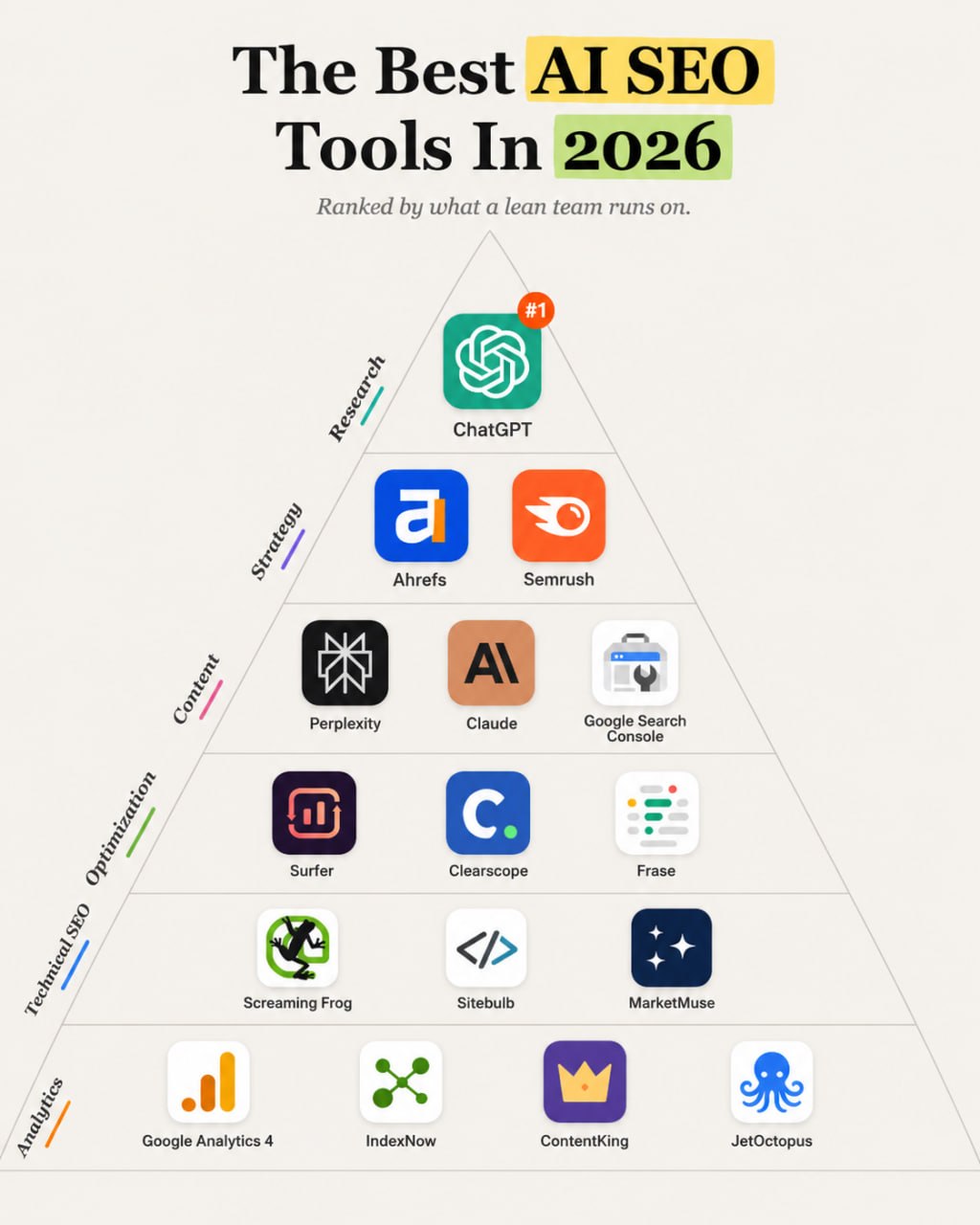
AI SEO tools can help a small team move faster, but they do not replace SEO judgment. The teams getting the most value in 2026 use AI to speed up research, outlines, content refreshes, internal linking, technical checks, and reporting. They still decide what the page should say, which claims need proof, and which opportunities matter to the business.
Quick answer: A lean AI SEO stack should start with ChatGPT or Claude for flexible analysis and drafting, Ahrefs or Semrush for keyword and competitor research, Google Search Console for real performance data, Surfer SEO or Frase for content briefs and optimization, and Screaming Frog for technical SEO checks. Bigger teams can add Clearscope, MarketMuse, Sitebulb, ContentKing, JetOctopus, or IndexNow when the workflow justifies it. AI Business Boomer helps small teams choose and connect tools like these into working content and automation systems instead of buying a pile of subscriptions.
SEO spans research, page planning, writing, optimization, technical crawl health, analytics, and updates. AI helps in each layer, but each layer has a different job.
If your business is still buying disconnected tools, start by defining the workflow. For many small teams, AI marketing automation, AI workflow automation, and AI blog writing tools matter more than another SEO dashboard.
Quick verdict
| Need | Best first choice |
|---|---|
| Best overall AI SEO assistant | ChatGPT |
| Best SEO research platform | Ahrefs or Semrush |
| Best free source of truth | Google Search Console |
| Best content optimization tool for lean teams | Surfer SEO or Frase |
| Best technical SEO crawler | Screaming Frog |
| Best editorial optimization option | Clearscope |
| Best advanced site auditing option | Sitebulb or JetOctopus |
| Best always-on monitoring option | ContentKing |
Do not try to buy every layer on day one. A useful stack beats a large stack.
Best AI SEO tools at a glance
Pricing and plan limits change often. Treat this table as buying guidance and check each vendor's current pricing page before subscribing.
| Tool | Best for | Category | Starting price | Key strength | Main limitation |
|---|---|---|---|---|---|
| ChatGPT | SEO analysis, outlines, briefs, rewrites, schema drafts, and content refresh support | AI assistant | Free and paid plans | Flexible work across the whole SEO process | Needs source material and human review |
| Claude | Long-form editing, content review, and cleaner rewrites | AI assistant | Free and paid plans | Strong editing and long-context review | Not a dedicated SEO platform |
| Ahrefs | Keyword research, backlink research, competitive analysis, and content gaps | SEO research platform | Paid plans | Strong link and competitor research | Cost can be high for casual users |
| Semrush | Broad SEO, PPC, competitor, content, local, and reporting workflows | SEO platform | Paid plans | Wide marketing toolkit | Can feel broad and expensive for one narrow job |
| Google Search Console | Indexing, query data, page performance, and search health | Analytics source of truth | Free | Real Google performance data | Limited keyword discovery and competitor data |
| Google Analytics 4 | Website behavior, conversions, landing page analysis, and channel reporting | Analytics | Free core product | Connects SEO to site behavior | Setup and attribution can confuse small teams |
| Surfer SEO | Content briefs, topical coverage, and on-page optimization | Content optimization | Paid plans | Practical editor workflow | Score chasing can flatten content |
| Frase | SERP research, briefs, outlines, and content optimization | Content workflow | Paid plans | Useful briefing workflow for lean teams | Still needs a writer or editor |
| Clearscope | Editorial content optimization and topic coverage | Content optimization | Paid and sales-led plans | Clean editorial guidance | Better fit for serious content teams |
| Screaming Frog SEO Spider | Site crawling, technical SEO audits, redirects, metadata, and internal links | Technical SEO | Free limited version and paid license | Reliable desktop crawler | Requires technical interpretation |
| Sitebulb | Technical audits and issue prioritization | Technical SEO | Paid plans | Clear visual audit reporting | More than a small site may need |
| ContentKing | Real-time SEO monitoring | Technical monitoring | Contact sales or paid plans | Ongoing change detection | Less useful before the site has many pages |
| JetOctopus | Large-site crawl analysis and log insights | Enterprise technical SEO | Contact sales or paid plans | Fast technical analysis at scale | Overkill for most small sites |
| IndexNow | Fast URL change notification for participating search engines | Indexing protocol | Free | Helps submit changed URLs faster | Does not guarantee indexing or ranking |
| Perplexity | Source discovery and research checks | Research assistant | Free and paid plans | Fast source exploration | Not a replacement for primary sources |
Read the evidence behind the recommendations
This guide compares tool roles and published capabilities. The evaluation weights below are a decision framework, not a claim that we ran a controlled benchmark across every product. For a firsthand AIBB example, inspect our own blog search data and publishing workflow. Read how we separate research, tests and examples before applying a conclusion to your own stack.
How we evaluated the tools
I evaluated each tool by the job it performs in an AI SEO workflow, not by brand awareness alone. The criteria were:
| Criterion | Weight |
|---|---|
| Use-case fit | 25% |
| Capability and output quality | 20% |
| Ease of use | 15% |
| Integrations and workflow fit | 15% |
| Price-to-value | 15% |
| Scalability and reliability | 10% |
The important distinction is the role of the tool. ChatGPT, Claude, and Perplexity help with thinking, drafting, and research. Ahrefs and Semrush give you SEO data. Surfer, Frase, Clearscope, and MarketMuse help shape content. Screaming Frog, Sitebulb, ContentKing, JetOctopus, and IndexNow sit closer to technical SEO. Google Search Console and GA4 tell you what happens after publishing.
Tools were excluded or de-emphasized when they were too narrow, redundant, too expensive for a lean team, or better suited to another article in the growth tools series.
The best AI SEO tools in 2026
ChatGPT: Best for flexible AI SEO work
ChatGPT is the best default AI assistant for SEO teams because it can support many parts of the workflow. It can turn keyword notes into briefs, cluster topics, rewrite intros, summarize Search Console exports, draft schema, produce FAQ ideas, and turn a published post into social or email copy.
It made this list because lean teams need a flexible assistant before they need a dozen specialized tools. ChatGPT works well when you give it real inputs: target keyword, audience, search intent, competitor notes, internal links, page goal, business offer, and source facts.
Important capabilities include:
- keyword and topic clustering from exported data
- article outlines, refresh plans, and FAQ drafts
- content rewrites and plain-English edits
- schema, metadata, and internal-linking suggestions
- summaries of crawls, analytics exports, or research notes
The main limitation is that ChatGPT does not know your real site performance, customer proof, pricing, internal links, or claims unless you provide them. It can also produce confident but unsupported text. Use it for drafting and analysis, then verify facts before publishing.
Choose ChatGPT if you want one broad AI layer for SEO and marketing work. Avoid using it as an unsupervised article factory. The closest alternative is Claude.
Claude: Best for long-form editing and content review
Claude is a strong AI assistant for reviewing long drafts, tightening prose, organizing rough notes, and turning messy source material into clearer sections. Many SEO teams use it after the first draft because it can improve structure and reduce generic writing.
It made the list because AI SEO content often fails in the edit. The draft may have the right keywords but weak examples, bloated sections, repeated claims, or a vague CTA. Claude can help a human editor find and fix that.
Important capabilities include:
- long-form article editing
- content gap review against a brief
- conversion of transcripts and notes into structured sections
- tone and clarity cleanup
- risk checks for unsupported claims
Claude is not a keyword database or technical crawler. It needs source material. Choose Claude if your bottleneck is editorial quality. Avoid it if you need crawl data, search volume, backlink research, or rank tracking. The closest alternative is ChatGPT.
Ahrefs: Best for SEO research and competitor analysis
Ahrefs is one of the strongest SEO research platforms for keyword research, backlink analysis, competitor content research, and content gaps. It is useful when your team needs to understand what already ranks, what competitors earn links for, and which pages might be worth building.
It made the list because AI cannot replace real SEO data. A language model can suggest topics, but Ahrefs helps you see search demand, ranking pages, link profiles, and competitor patterns.
Important capabilities include:
- keyword research and difficulty signals
- backlink and referring domain analysis
- competitor page and content research
- site audit features
- rank tracking and SEO reporting
Ahrefs fits teams that care about organic strategy beyond article drafting. Its limitation is cost and learning curve. A small business that publishes one post per month may not need a full subscription. Choose Ahrefs when research quality matters. Avoid it if you only need light topic ideas. The closest alternative is Semrush.
Semrush: Best broad SEO and marketing suite
Semrush is a broad SEO and digital marketing platform. It covers keyword research, competitor analysis, site audits, rank tracking, content tools, local SEO, PPC research, and reporting. Semrush also publishes its own AI SEO tool guidance and has been adding AI search visibility features.
It made the list because many growth teams want one place for SEO, paid search research, competitor monitoring, and content planning. That can reduce context switching if the team actually uses the wider platform.
Important capabilities include:
- keyword, competitor, and SERP research
- technical site audits
- rank tracking and reporting
- content and topic workflows
- PPC and competitive marketing research
Semrush can become too much tool for a lean team if the team only needs one SEO research job. Choose Semrush when you want a broader growth and SEO platform. Avoid it when you need a narrower, cheaper setup. The closest alternative is Ahrefs.
Google Search Console: Best free SEO source of truth
Google Search Console is required for any serious SEO workflow. It shows which queries and pages get impressions, clicks, indexing issues, crawl signals, sitemap status, and search performance from Google.
It made the list because many AI SEO workflows skip the source of truth. Teams brainstorm new content while ignoring the pages already getting impressions. Search Console helps you decide what to refresh, which queries need better pages, and where Google sees problems.
Important capabilities include:
- query, click, impression, and average position data
- indexing and sitemap visibility
- page experience and crawl issue signals
- URL inspection
- performance comparisons over time
Search Console does not give you full competitor data or clean conversion reporting. Pair it with GA4, Ahrefs, Semrush, or a content optimization tool. Choose it for every site. There is no credible substitute for Google performance data.
Google Analytics 4: Best for connecting SEO to behavior
Google Analytics 4 helps teams understand what users do after they arrive. It can show landing page behavior, traffic channels, conversion events, engagement, and funnel patterns when configured correctly.
It made the list because SEO traffic without business context can waste effort. A post that gets clicks but no leads may need a better offer, internal link, CTA, or audience fit.
Important capabilities include:
- landing page and channel reporting
- event and conversion tracking
- audience and engagement analysis
- integration with Google Ads and other Google tools
- custom exploration reports
GA4 can confuse small teams. Bad setup leads to bad decisions. Choose GA4 when you need to connect content to behavior and conversions. Avoid making large decisions from unconfigured reports. The closest alternatives are privacy-focused analytics tools, but GA4 remains the common baseline.
Surfer SEO: Best practical content optimization workflow
Surfer SEO helps teams build content briefs, compare topical coverage, and optimize drafts against SERP-informed recommendations. It is useful when a writer needs structure and a content editor wants a repeatable checklist.
It made the list because content optimization is where many teams need help after research and before publishing. Surfer can show missing topics and terms, but the editor still has to protect the article from becoming generic.
Important capabilities include:
- content editor and optimization scoring
- keyword and topical recommendations
- brief and outline workflows
- content audit and refresh support
- integrations with common writing workflows
The limitation is score chasing. A high score does not mean the article is useful, differentiated, or commercially relevant. Choose Surfer when you publish regularly and have an editor. Avoid it if your team will blindly follow every recommendation. The closest alternative is Frase.
Frase: Best lean SERP brief workflow
Frase helps teams research the SERP, create briefs, build outlines, and optimize drafts. It is a strong fit for lean teams that need more structure than a general AI assistant gives them but do not want an enterprise content platform.
It made the list because briefs matter. Good SEO articles start with search intent, competing pages, likely questions, and a clear angle. Frase helps turn that into a working document.
Important capabilities include:
- SERP research and competitor heading review
- content brief creation
- outline and question research
- content optimization guidance
- writer-friendly workflow
Frase still needs human judgment. Do not copy competitor structure just because the SERP shows it. Choose Frase if your team needs practical briefs. Avoid it if your current bottleneck is technical SEO or analytics. The closest alternative is Surfer SEO.
Clearscope: Best editorial-grade content optimization
Clearscope helps teams improve topical coverage and editorial quality. It is often a better fit for serious content teams than casual publishers because it supports a clean review process and strong writer guidance.
It made the list because some teams care less about fast drafts and more about high-quality pages that can be updated over time. Clearscope fits that motion.
Important capabilities include:
- content optimization reports
- relevant term and topic guidance
- writer and editor collaboration
- content refresh support
- integrations with writing workflows
The limitation is price-to-value for small teams. If your blog is still occasional, Clearscope may be more than you need. Choose Clearscope for important content programs. Avoid it for low-volume or budget-sensitive publishing. The closest alternatives are Surfer SEO and Frase.
Screaming Frog SEO Spider: Best technical SEO crawler
Screaming Frog SEO Spider is a desktop crawler used by many SEO professionals. It helps you inspect titles, descriptions, status codes, canonicals, redirects, internal links, images, structured data, and many other technical signals.
It made the list because AI SEO still depends on crawlable, healthy pages. A good article cannot perform well if the site has broken links, duplicate canonicals, noindex errors, missing metadata, or messy redirect chains.
Important capabilities include:
- crawl status and response code checks
- metadata, canonical, and heading review
- internal-link analysis
- broken link and redirect discovery
- structured data extraction and validation support
Screaming Frog requires interpretation. It gives you the data, not the business decision. Choose it if you need a reliable technical audit tool. Avoid it if nobody on the team can act on crawl findings. The closest alternative is Sitebulb.
Sitebulb: Best technical SEO audit reporting
Sitebulb is a technical SEO auditing tool that turns crawl data into clearer reports and issue prioritization. It is useful when a team needs to explain technical problems to non-technical stakeholders.
It made the list because technical SEO work often stalls when the report is too dense. Sitebulb can make the audit easier to review and prioritize.
Important capabilities include:
- technical crawl audits
- issue prioritization
- visual reports and hints
- internal-link and site architecture analysis
- audit history
Sitebulb is stronger when the site has enough pages and technical complexity to justify it. Choose Sitebulb if you need better audit communication. Avoid it if Screaming Frog plus a checklist is enough. The closest alternative is Screaming Frog.
ContentKing: Best always-on SEO monitoring
ContentKing monitors a site continuously and alerts teams when important pages change or issues appear. That is useful when several people publish, edit, or deploy pages.
It made the list because SEO problems often happen between audits. A noindex tag, changed title, broken canonical, or deleted page can sit unnoticed until traffic drops.
Important capabilities include:
- real-time SEO monitoring
- change tracking
- alerting for important issues
- page-level auditing
- team reporting
ContentKing is not the first tool a small site needs. Choose it when your site changes often and SEO pages have business value. Avoid it if you have a small static site and run periodic crawls. The closest alternatives are Sitebulb and other monitoring tools.
JetOctopus: Best for advanced technical SEO at scale
JetOctopus is built for large-site technical SEO, fast crawling, log analysis, and deeper crawl insights. It fits ecommerce, marketplaces, publishers, and enterprise sites more than simple service-business websites.
It made the list because some growth teams need scale. If the site has thousands or millions of URLs, desktop crawlers and light audits can become slow or incomplete.
Important capabilities include:
- large-scale crawling
- log file analysis
- indexability and crawl budget analysis
- technical SEO dashboards
- segmentation for large sites
JetOctopus is overkill for most lean teams. Choose it when technical scale is the problem. Avoid it for a small marketing site. The closest alternatives are enterprise crawlers and log analysis tools.
IndexNow: Best supporting protocol for URL changes
IndexNow is a protocol that lets sites notify participating search engines when URLs are created, updated, or deleted. It is not a ranking tool, and it does not guarantee indexing. It can help search engines discover changes faster.
It made the list as a supporting layer, not a core SEO platform. It is useful for sites that publish or update content frequently and want a cleaner notification workflow.
Important capabilities include:
- URL update notification
- support from participating search engines
- low-cost implementation
- useful add-on for CMS and publishing workflows
IndexNow should not replace sitemaps, internal links, canonical hygiene, or Search Console checks. Choose it as a support layer. Avoid treating it as an SEO shortcut. The closest alternative is normal sitemap and URL inspection workflows.
Perplexity: Best source discovery assistant
Perplexity is useful for source discovery, quick research checks, and finding current pages around a topic. It can help an SEO editor move faster during research, especially when paired with primary-source verification.
It made the list because AI SEO workflows need source discipline. Perplexity can help find official docs, pricing pages, support pages, and recent discussions. It should not become the source of truth.
Important capabilities include:
- quick source discovery
- summarized research paths
- follow-up research questions
- citation-oriented exploration
- fast comparison work
The limitation is reliability. Always open the source. Choose Perplexity for research acceleration. Avoid citing it when the primary source is available. The closest alternative is normal web search plus manual source review.
Recommended AI SEO stacks by team type
Solo operator
Use ChatGPT, Google Search Console, GA4, and Frase. Add Screaming Frog when the site has enough pages to audit. This stack keeps costs lower and covers the basics: drafting, real performance data, content briefs, and technical checks.
Skip Clearscope, ContentKing, and JetOctopus until SEO drives enough leads to justify more subscriptions.
Lean startup
Use ChatGPT or Claude, Ahrefs or Semrush, Google Search Console, GA4, Surfer SEO, and Screaming Frog. This gives the team research, content optimization, analytics, and technical visibility without building an enterprise stack.
Pick one research platform. Do not pay for Ahrefs and Semrush unless different team members use different parts of the workflow.
Agency
Use Semrush or Ahrefs, Surfer SEO or Clearscope, Screaming Frog, Sitebulb, GA4, Search Console, and ChatGPT or Claude. Agencies need repeatable briefs, audits, reporting, and client-friendly explanations.
Sitebulb can help when technical findings need to become client-ready reports. Clearscope can help when the agency sells higher-end editorial SEO.
Mid-market or enterprise team
Use Ahrefs, Semrush, Clearscope or MarketMuse, ContentKing, JetOctopus, GA4, Search Console, and a secure AI assistant workflow. Larger teams need monitoring, governance, scale, permissions, and clear source-of-truth rules.
The risk is overlap. Decide which platform owns keyword research, which owns content optimization, which owns technical monitoring, and which owns reporting.
Technical SEO team
Use Screaming Frog, Sitebulb, JetOctopus, ContentKing, Search Console, log analysis, GA4, and an AI assistant for summarizing crawl findings. This stack focuses on crawlability, indexability, internal links, templates, and deployment issues.
Do not let AI summarize crawl exports without checking the actual rows. The model can help triage patterns, but the technical owner still validates the fix.
How to choose the right AI SEO tool
Start with the workflow:
| Buying question | What to decide |
|---|---|
| Team size | Solo owners need fewer tools. Agencies and larger teams need workflow control, permissions, and reporting. |
| Primary workflow | Research, content, technical SEO, monitoring, and analytics need different tools. |
| Existing stack | Do not add a platform that duplicates data you already trust. |
| Integrations | Check CMS, Google Search Console, GA4, Google Docs, WordPress, Webflow, and reporting integrations. |
| Budget | One AI assistant plus one SEO layer can beat five half-used tools. |
| Learning curve | A tool your team ignores has no value. |
| Data ownership | Be careful with client data, unpublished strategy, private analytics, and customer information. |
| Scalability | Large sites need crawl speed, monitoring, segmentation, and logs. |
| Switching costs | Content workflows, briefs, reports, and dashboards can become hard to migrate. |
The highest-return first move is usually not a new subscription. It is a clear SEO operating rhythm:
- Pull Search Console and GA4 data.
- Pick pages to create, refresh, or consolidate.
- Use Ahrefs or Semrush for the competitive view.
- Build the brief in Frase, Surfer, or a structured doc.
- Draft and edit with ChatGPT or Claude.
- Check crawl health with Screaming Frog.
- Publish, link internally, submit the sitemap, and monitor.
That workflow keeps the tools in their place.
Tools we considered but did not rank
MarketMuse is credible for content strategy and topic modeling, but it often fits mature content teams more than lean teams. It belongs on the shortlist when content planning is a major channel.
Lumar, Botify, and Oncrawl are strong technical SEO platforms, but they make more sense for enterprise sites than small growth teams.
Yoast SEO and Rank Math are useful WordPress SEO plugins, but they are CMS plugins rather than full AI SEO tools. They help with metadata, schema, and page checks, but they do not replace research, writing, analytics, or technical audits.
Alli AI and similar SEO automation products can be useful for specific workflows, but teams should inspect what the software changes and keep rollback control.
NotebookLM can help summarize source documents, but it is better suited to research and knowledge workflows than a dedicated SEO stack.
Final recommendation
Most lean growth teams should start with this stack:
- ChatGPT or Claude for analysis, briefs, drafts, rewrites, and content refresh support
- Ahrefs or Semrush for keyword, competitor, and SERP research
- Google Search Console and GA4 for performance and behavior data
- Surfer SEO or Frase for briefs and content optimization
- Screaming Frog for technical SEO checks
That stack covers the full workflow without creating too much overlap. If content quality becomes the bottleneck, add Clearscope. If technical issues change often, add ContentKing or Sitebulb. If the site is large, evaluate JetOctopus.
For a small business, the best tool choice is the one that produces published, accurate, useful pages tied to a real offer. If the team buys tools but never builds a repeatable publishing and review process, the stack will not matter.
Sources to check before buying
Keep building the system
Recommended next Business Boomer guides
These links are selected by topic and search intent so this guide connects to the most relevant service pages, industry pages, and supporting blog posts.
Service and setup pages
Use these when you are ready to turn the idea into an implementation path.
Industry-specific pages
See how the same workflow changes for specific business types.
Related blog posts
Read the connected guides that support this topic cluster.
Related AI automation guides
Keep going with the connected Business Boomer guides in this automation cluster.
Best invoicing automation tools for small business
A comparison of QuickBooks, FreshBooks, Stripe Billing, Wave, Jobber, Housecall Pro, Zapier, and Make.
Best AI automations for contractors
Field notes, estimate follow-up, scheduling, internal handoffs, and admin workflows.
AI automation services for local small business
Planning examples for broader automation. Compare current managed calls and reviews on the Services page; confirm other work in a separate scope.
AI automation for local service businesses
Practical lead, scheduling, review, CRM, invoice, and admin automation for plumbers, HVAC companies, roofers, landscapers, cleaners, contractors, and other local operators.
FAQ
Quick answers about this guide and how to put the idea into practice.
What is the best AI SEO tool in 2026?
For most lean growth teams, ChatGPT is the best flexible AI assistant, Ahrefs or Semrush is the best SEO research layer, Surfer SEO is a practical content optimization layer, Google Search Console is the required performance source of truth, and Screaming Frog is the most common technical crawler.
Can one AI SEO tool replace a full SEO stack?
No. One tool can help with a piece of the workflow, but SEO still needs keyword and competitor research, content planning, technical crawling, analytics, internal links, updates, and human review.
Should a small team choose Ahrefs or Semrush?
Choose Ahrefs if backlink research, competitive content analysis, and straightforward SEO research matter most. Choose Semrush if you want a broader marketing and SEO suite with keyword research, competitive data, PPC, content, local, and reporting features.
Are AI SEO tools safe to use for Google rankings?
AI-assisted SEO can be safe when the content is useful, accurate, original, and reviewed by a person. Google warns against scaled content abuse and content made mainly to manipulate rankings.
What should a lean AI SEO stack include first?
Start with ChatGPT or Claude for drafting and analysis, Ahrefs or Semrush for research, Google Search Console for real performance data, Surfer SEO or Frase for content briefs, and Screaming Frog for technical checks.
Find the workflow worth fixing first.
Use the Free 30-Minute AI Consultation to map where leads, reviews, content, or follow-ups are slipping and choose the smallest useful next step.
Book a Free 30-Minute AI Consultation