
How We’re Growing Our Blog with AI: The Results and the Workflow

Author
Business Boomer StaffEditorial Team
The Business Boomer Staff profile is used for general guides, announcements, and educational resources created or maintained by the Business Boomer editorial workflow.
Our actual search data, the workflow changes behind our publishing process, and a free kit of skills, automation prompts and measurement templates.
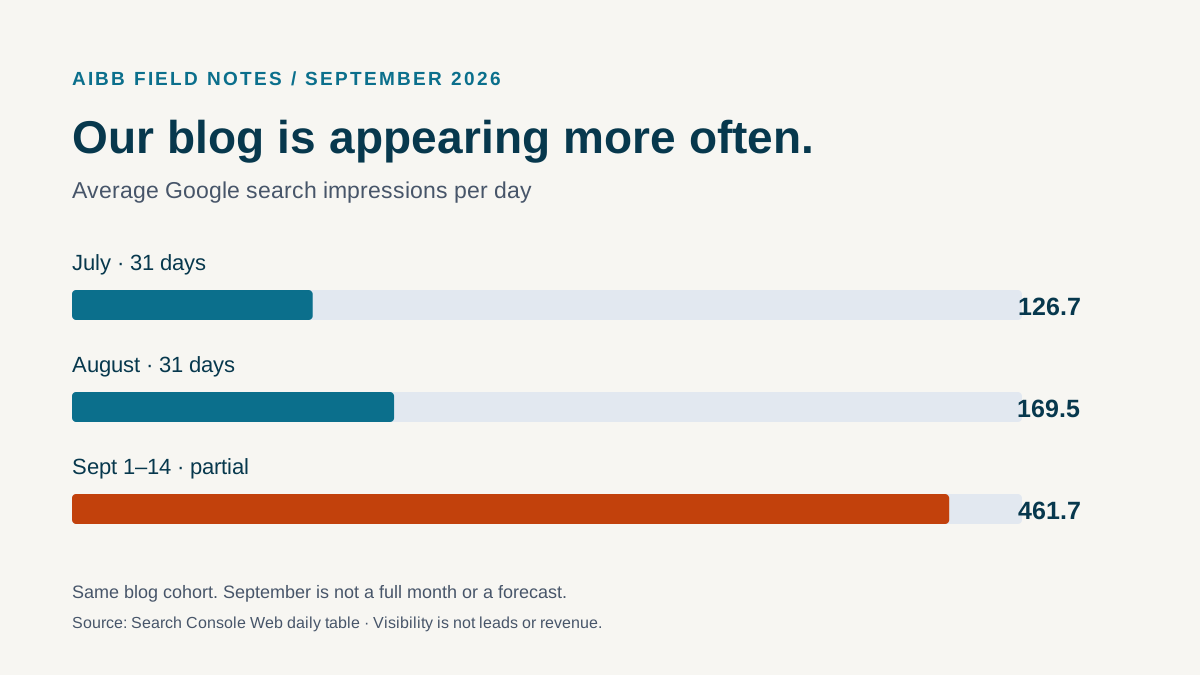
Our blog earned 3,929 Google search impressions in July and 5,253 in August 2026, a 33.7% increase across two complete months. September 1–14 added 6,464 impressions. That partial month averaged 461.7 impressions per day, compared with 169.5 in August.
We use AI to help research, write, improve and check the work, supported by reusable instructions, focused project records and scheduled reviews. Below is the evidence, what we changed, and a practical way to build your own version.
Download the free blog growth replication kit (ZIP) — four portable skills, automation prompts, a project template, review rubric, change log and our dated search data. No email required.
Our month-by-month search results
Our own search data · July–September 2026
More visibility. The clicks still need work.
Same blog cohort, compared per day. September covers 14 days; July and August each cover 31.
Average daily impressions · scale 0–500
July → August: +33.7% impressions over two full months. September’s observed daily rate is 2.72× August’s, not a full-month result or forecast.
| Period | Days | Impressions | Clicks | CTR |
|---|---|---|---|---|
| July | 31 | 3,929 | 8 | 0.20% |
| August | 31 | 5,253 | 12 | 0.23% |
| September 1–14 | 14 | 6,464 | 10 | 0.15% |
Source: Search Console daily table, read September 16, 2026. Web search; pages containing aibusinessboomer.io/blog/. Dates use Pacific Time. Filtered data can be partial. These are search appearances and clicks, not ChatGPT referrals, leads or revenue.
Download the daily data (CSV)An impression means our page appeared in search; a click means someone followed a result to the site. Our monthly blog clicks were 8 in July, 12 in August and 10 during September 1–14. The click counts are small. Increased visibility is a useful early signal, but it is not evidence of a comparable increase in customers or revenue.
For an equal-length comparison, July 21–August 17 versus August 18–September 14 produced 4,209 → 9,106 blog impressions, 14 → 15 clicks, and a reported average position of 34.6 → 18.2. Lower position numbers are better. Average position also changes with the mix of queries; this does not mean every keyword moved up by the same amount.
The chart uses the daily table from Google Search Console, read September 16, with Web search and a page filter containing https://aibusinessboomer.io/blog/. Daily sums supply the exact impression and click totals; the interface rounds its summary cards. September ends on the latest complete date available in our review, September 14. Filtered reports can be partial. This is Google visibility, including eligible Google AI search appearances, not a ChatGPT traffic report. Google’s reporting explanation.
Which pages are driving the increase?
In the same two 28-day periods, a small number of existing pages supplied much of the growth:
| Existing article | Earlier impressions | Later impressions | Later clicks |
|---|---|---|---|
| Video-editing tools | 293 | 2,514 | 1 |
| AI blog-writing tools | 67 | 1,005 | 0 |
| AI automation partners | 198 | 443 | 1 |
| AI website builders | 283 | 476 | 1 |
The first two pages added 3,159 impressions between them. Our working interpretation is that specific comparison and workflow questions are earning visibility. The evidence supports improving those useful pages; it does not establish that every new article or every AI-generated paragraph will perform.
The next challenge is clear: give the right reader a compelling reason to click and a useful next step once they arrive. Our guide to impressions without clicks explains how to diagnose that gap.
What we changed—and when
The dates matter. Some of our current process improvements happened after the rise began.
| When | Change | What the evidence supports |
|---|---|---|
| Before September 8 | Existing comparison guides were already earning more visibility. | The increase was underway before the refresh package below. |
| September 8 | We refreshed three priority guides, corrected source-backed product details, added three worksheets and improved discovery links. A separate Search Console guide also went live. | These were published improvements to already-relevant content. They cannot explain the beginning of the rise. |
| September 8 onward | Daily draft production continued even when publication was held. | A blocked release no longer prevented a complete new draft. A saved draft still was not counted as a published page. |
| September 9 operating revision | One focused task became responsible for each outcome; concise project records and source links replaced mandatory coordinator relays for routine work. | This describes our working structure. We have not measured its independent effect on rankings or productivity. |
| September 15 | The daily publisher received standing authority to publish one current-day article after all required checks pass. | This began after the chart’s September 14 cutoff, so it did not cause the growth shown here. |
| September 16 | We expanded the video guide with our Codex/HyperFrames process and new editorial images. | The update is live. Its search effect has not yet been measured. |
We cannot separate our work from changes in search demand, competitors, Google’s systems or query mix. This is an observed improvement alongside a documented process, not a controlled claim that AI caused a particular uplift.
The structure: one owner, reusable skills, visible evidence
Our system keeps four kinds of information separate:
| Record | What belongs there | Why it helps |
|---|---|---|
| Project memory | Current facts, decisions and one next action | The assistant can resume without guessing what is current. |
| Work scope | The requested outcome, boundaries and completion check | The task stays focused on a deliverable. |
| Sources | Links to original research, analytics and release evidence | Claims can be checked instead of repeated from memory. |
| Tools | Available capabilities and recent access checks | A configured connection is not assumed to work. |
One focused task owns the outcome. It loads the relevant context, selects the procedure it needs, completes the work and records evidence. Additional agents are optional when an independent subtask warrants them; a large team is not a prerequisite.
A skill is a reusable set of instructions for doing a job. An automation runs a defined job on a schedule. Neither replaces the source data, grants publication permission or proves that a useful result was delivered.
The skills readers can reuse
Our public skills catalog includes AIBB’s writer, content optimizer, auditor and SEO quality-review procedures. Some catalog downloads retain older AIBB-specific roles and dependencies. Read and adapt them before use.
For this case study, we also made a portable public starter kit from the current working method. Its names and packaging are new; we are not claiming these exact files produced the historical results.
| Skill in the starter kit | Job | Concrete output |
|---|---|---|
blog-research-brief | Check reader intent, existing coverage and current primary sources | One evidence-backed brief with a refresh-or-new-page decision |
blog-draft | Turn that brief into a complete useful article | Draft, metadata, internal links, sources and open checks |
blog-refresh | Improve a page already earning relevant impressions | Revised page plus a dated before/after change log |
blog-release-review | Review claims, duplication, build and rendered output | A verified release receipt or a specific hold |
Download all four skills and supporting templates. In a Codex project, copy each skill folder into .agents/skills/, read its instructions, and replace the project template with your own domain, offer, audience and release rules. Other assistants can use the Markdown as procedural instructions. Analytics access, publishing tools and any paid services must be configured separately.
The automations we currently run
These are the saved schedules as of September 16, in America/New_York time. The replication kit contains editable prompts, not an installer that silently enables them.
| Schedule | Job | Completion check |
|---|---|---|
| Daily, 9 AM | Research and produce one complete current-day article | Dated draft and index entry exist, with evidence and any unresolved checks |
| Daily, 2 PM | Improve that candidate and publish only if eligible | Editorial threshold and every required check pass; public content and canonical URL are verified |
| Monday, 10 AM | Read-only website and SEO health review | Tested routes, source-period metrics, defects and prioritized actions are saved |
| Friday, 1 PM | Weekly growth scorecard | Equal-period comparison, data limitations and one useful next action are delivered |
Our publication threshold is 85/100 plus passing factual, duplicate, source, build, rendered-preview and destination checks. The score is an internal editorial checklist, not a Google ranking metric. A failed check blocks release regardless of score. The ZIP includes a clearly labeled starter rubric you can adapt.
The September 15 scheduled afternoon run produced a live article about testing AI receptionist hours, with a saved release receipt and public readback. That is evidence of an executed publishing cycle, not proof that every future scheduled run will succeed.
Daily publishing is our current operating choice, not a proven ranking requirement. If your business cannot produce a distinct, useful article every day, use a slower cadence. Never invent a topic merely to fill a slot or publish an old draft as today’s work.
We have also had analytics authentication failures. A successful schedule configuration does not prove the underlying data was fetched. When access fails, use an explicitly dated relevant export or mark the metric unavailable; do not turn missing values into zero. The growth chart here was verified directly in the signed-in Search Console report.
Replicate the process with one page first
- Choose one audience and one offer. Write down the practical question a potential customer needs answered. Inventory existing pages so you do not create a near-duplicate.
- Save a baseline. Export page and query data for a complete period. Record cohort, dates, impressions, clicks and relevant positions. Keep leads and revenue in separate verified fields.
- Select a useful existing page. Look for relevant impressions and a clear gap: an incomplete answer, stale comparison, missing example or weak next step.
- Make a material improvement. Add checked information and something the reader can use: a worked example, decision table, checklist or worksheet. Preserve a useful canonical URL.
- Review the real page. Inspect desktop and mobile, links, images, metadata and sources. Publish within your authority, then read the public result back.
- Record the change and measure again. Check delivery immediately; compare the same cohort after a complete post-change period. A ranking movement is an observation until you can justify a causal claim.
- Schedule only after a successful manual cycle. Start with the draft and weekly review prompts. Grant a publisher narrowly defined authority only when your checks and recovery path are reliable.
Use the kit’s blank scorecard and change log for your own results. Our CSV is included so you can inspect this case study’s arithmetic, not copy our performance into your business’s report.
Google allows useful applications of generative AI, but warns against producing many pages without added value. Our aim is to make the answer, evidence and delivery process better—not to treat volume as the outcome. Google’s guidance on generative AI content.
What we are improving next
The growth in impressions gives us better information about which questions Google is surfacing our pages for. We will use it to improve query relevance, search presentation, original examples and the path from useful advice to a relevant service conversation. We will measure qualified inquiries separately before claiming business growth.
Get the replication kit and start with one page. If you want help adapting the process to your business, book a consultation and bring your site, one customer question and your current search data.
Run your own measurable experiment
Choose one page, save its current search data, and write down what you expect the change to improve. Record the release date before reviewing the results. Compare equal complete periods and show clicks alongside impressions and position.
Download the SEO experiment worksheet and six-step measurement guide. The worksheet is blank apart from a labeled example; it does not promise a result. Keep reader clicks, downloads, inquiries, and sales separate.
Keep building on this guide
Practical guides, examples, and resources you can use in your own business.
Frequently Asked Questions
FAQ
Quick answers about this guide and how to put the idea into practice.
Did AI cause AIBB’s search growth?
We observed more blog impressions and improved average position while using an AI-assisted publishing process. This is an observational case study, not a controlled test. The data cannot isolate AI, a particular skill or a single edit as the cause.
Can I download the skills and automations?
Yes. The free replication kit includes four portable skill templates, scheduler prompts, project structure, a review rubric and measurement files. Configure your own tools, permissions and schedules; downloading the kit does not install or activate automations.
Does this measure ChatGPT traffic?
No. These figures come from Google Search Console’s Web report for our main-domain blog pages. They do not measure ChatGPT referrals, qualified leads or revenue.