
How Phoenix Is Turning Her TMJ Journey Into a Website With AI Agents
Phoenix Alix has spent years trying to understand TMJ. Now she is using AI agents to turn that lived experience into a website, community, and service business.



Phoenix Alix did not start with a business plan.
She started with a jaw that clicked when she opened her mouth.
The clicking began when she was around 13. At first, it was annoying. Then the pain started. She saw a TMJ specialist, got a splint, and wore it every day. The splint helped her bite feel more comfortable, but it did not answer the bigger question she kept running into: why was this happening in the first place?
Years later, after braces, a displaced disc, locked jaw, Botox, physical therapy, several doctors, and a palate expander, Phoenix still had the same feeling many people with TMJ describe. She had tried a lot, learned a lot, and still did not feel like the internet explained the daily reality very well.
That is the part that can become a business.
This article is not medical advice. It is the story of how one person is turning lived experience, hard-won knowledge, and a personal problem into a website with help from AI agents.

Quick read
| Piece | What it means for Phoenix's project |
|---|---|
| Personal story | Phoenix has lived with jaw clicking, pain, clenching, grinding, locked jaw, and years of trial-and-error care. |
| Website angle | The site can explain TMJ-related tension in a calmer, more human way than most generic health pages. |
| Business path | Her facial massage and buccal massage work give the content a real local service behind it. |
| AI role | The AI agent helps turn Phoenix's notes, stories, and service ideas into pages, posts, and a publishing plan. |
The problem Phoenix kept running into
Phoenix said the first signs were clicking, popping, pain, clenching, grinding, headaches, trap pain, and eventually locked jaw when her disc became displaced.
She learned the term TMJ by researching on her parents' computer. Technically, everyone has a temporomandibular joint. When people say they "have TMJ," they usually mean they are dealing with a disorder or pain around that joint.
The frustrating part was not only the pain. It was the way the answers felt scattered.
Phoenix heard about splints, braces, Botox, physical therapy, orthodontics, surgery, and palate expansion. Some doctors looked at the jaw. Others looked at the bite. One doctor helped her think about airway, structure, tongue posture, and muscle tension as connected pieces.
That changed how she understood the issue.
"There's more to your jaw than just your jaw. It's all connected. Your traps, your airways, your tongue posture, all of it is working together."
Phoenix Alix
Why normal TMJ content misses the lived experience
Phoenix does not think most websites explain how TMJ interrupts normal life.
Eating can hurt. Talking for a long time can hurt. Hanging out with friends can lead to jaw massage afterward. Headaches, neck pain, clenching, grinding, and upper-body tension can all become part of the day.
That is the gap Phoenix wants the website to address: a place where people dealing with jaw tension and TMJ-related pain can feel less alone, learn from personal stories, and find practical resources to explore with the right professionals.
The tone matters. The site should feel calm and grounded, not clinical or panic-driven.
Phoenix also noticed something important when she shared her palate expander journey on TikTok: people showed up. There was a community around it. Other people had questions. Other people were tired too.
That is usually where a useful small business starts.
The website idea
Phoenix wants the website to be personal, educational, community-based, and connected to her local services.
The first version can do a few simple things:
- Lead with Phoenix's story: Share what she has lived through, what she has tried, and what she wishes she understood earlier.
- Keep the education careful: Explain patterns and questions without turning the site into medical advice.
- Publish practical posts: Answer the questions people ask when their jaw hurts, their face feels tense, or they feel stuck.
- Invite community: Give visitors a reason to share their own experiences and come back.
- Connect to local service: Help local visitors understand Phoenix's facial massage and buccal massage work.
- Make booking clear: Point people toward the next step when they want in-person support.
She also has a larger idea for the future: classes or education that teaches people how she thinks about releasing tension and supporting the body. That does not need to happen on day one. The website can start with the story, the service, and the first useful posts.
When Sam asked what someone should feel if they land on the site at 11 PM because their jaw hurts, Phoenix had a clear answer.
She wants them to feel softer in their body.
That is good website direction. It tells us the page should not feel clinical, frantic, or sales-heavy. It should feel calm, human, and practical.
Where AI agents changed the first step
Phoenix said she probably would not have started building a website or company around this without help.
The idea was strong. The work around the idea felt heavy.
She wants to spend her energy learning, practicing, and helping people. Building a website, planning content, organizing pages, writing posts, and figuring out the business structure all felt like another job.
The AI agent changed that first step.
It gave her a way to turn what was already in her head into something visible: a website structure, content ideas, blog angles, service pages, and a plan for what to publish first.
That is the point small business owners should pay attention to.
AI does not replace the lived experience. Phoenix still has the story. Phoenix still has the judgment. Phoenix still has to decide what feels true, useful, and responsible.
The AI agent helps organize the work around that knowledge.
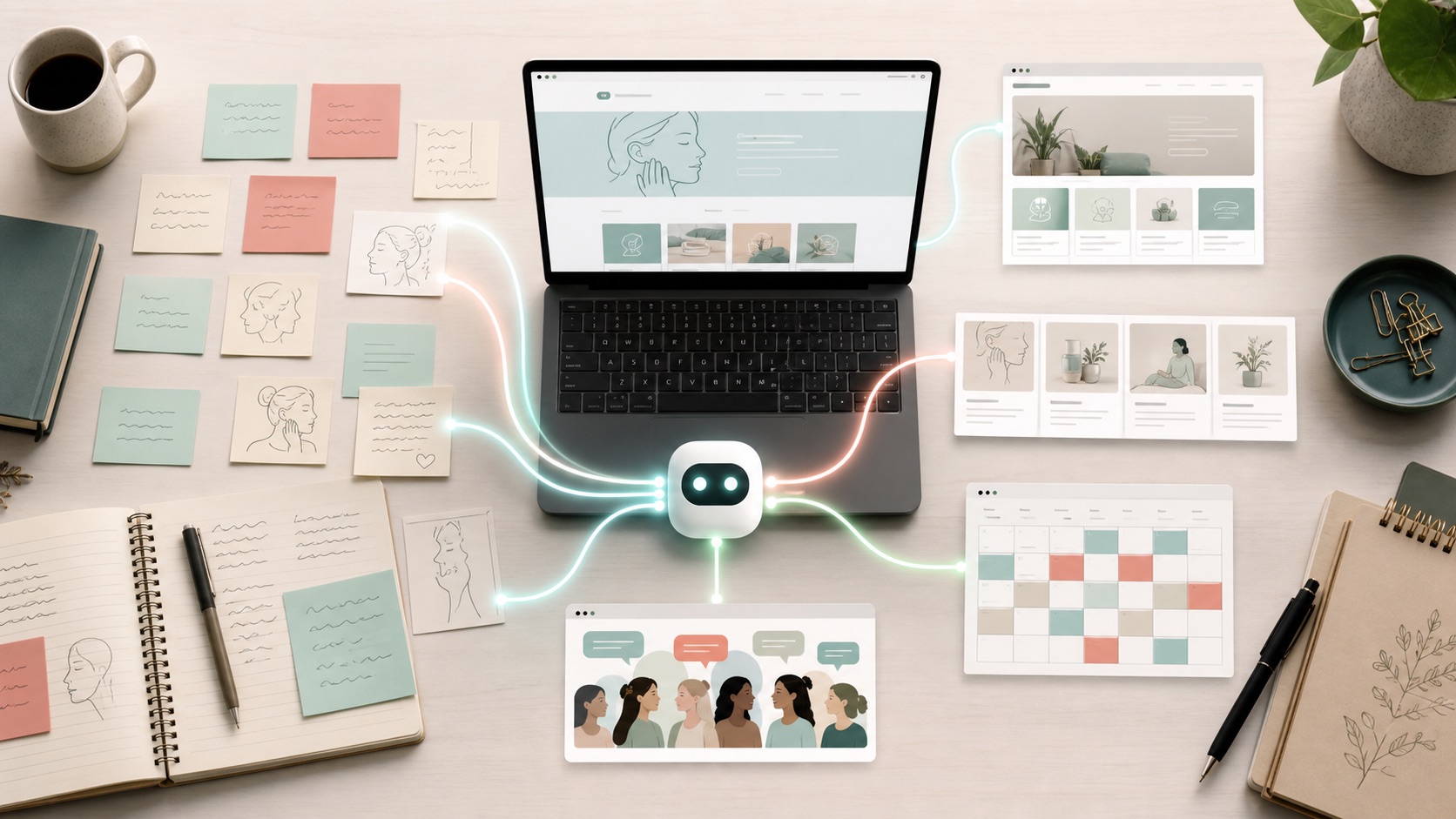
How the AI work breaks down
| Phoenix brings | The AI agent helps turn it into |
|---|---|
| Her TMJ timeline | A clear story arc for the website and blog |
| Questions people ask her | Article ideas, FAQs, and social post topics |
| Her treatment experience | Careful educational content with medical-claim boundaries |
| Her service skills | A service page that explains facial massage, buccal massage, and tension-focused work |
| Her next 30-day goal | A launch checklist with pages, posts, and sharing steps |
The business lesson
A lot of people have the seed of a business sitting inside a personal experience.
They know a problem because they lived it. They know what websites explain badly. They know what confused them at the beginning. They know what people ask when they are tired, frustrated, or overwhelmed.
The hard part is turning that knowledge into a real asset.
That is where AI Business Boomer helps.
We take the messy middle of a small business idea and turn it into pages, content, follow-up systems, and working workflows. The goal is not to make every founder sound like a tech company. The goal is to help a real person get their idea into the world with less friction.
Phoenix's TMJ website is a good example:
- Real experience: Phoenix knows the problem because she has lived it.
- Useful content: The first product is education, story, and clarity.
- Commercial path: Her local service gives the site a practical next step.
- Community: People with similar questions have a reason to return.
- AI support: The agent turns scattered knowledge into a working system.
What should happen next
The next 30 days should stay simple.
Phoenix said the project would feel real if the website went live and she started sharing short pieces of her own experience.
That is the right first milestone.
Start with the story. Add the first few blog posts. Make the service clear. Invite people into the conversation. Keep the medical claims careful. Let the website grow from real questions instead of trying to perfect the whole business before anyone sees it.
That is how small businesses actually begin.
One person says, "I know this problem, and I can help explain it." Then the first page, the first post, and the first offer give the idea a place to live.

If you have an idea sitting in your head and you are not technical enough to build it alone, AI Business Boomer can help you turn it into a website, content system, and practical next step.
Keep building the system
Recommended next Business Boomer guides
These links are selected by topic and search intent so this guide connects to the most relevant service pages, industry pages, and supporting blog posts.
Service and setup pages
Use these when you are ready to turn the idea into an implementation path.
Industry-specific pages
See how the same workflow changes for specific business types.
Related blog posts
Read the connected guides that support this topic cluster.
Related AI automation guides
Keep going with the connected Business Boomer guides in this automation cluster.
AI assistant for local business
Owner-controlled AI assistants that help local businesses handle missed leads, scheduling handoffs, FAQs, reviews, CRM updates, and follow-up.
OpenClaw operator setup sprint
A setup page for private owner-controlled OpenClaw operators with messaging access, business context, approval rules, and one proven workflow.
AI automation services for local small business
Planning examples for broader automation. Compare current managed calls and reviews on the Services page; confirm other work in a separate scope.
AI automation for local service businesses
Practical lead, scheduling, review, CRM, invoice, and admin automation for plumbers, HVAC companies, roofers, landscapers, cleaners, contractors, and other local operators.
FAQ
Quick answers about this guide and how to put the idea into practice.
What is the main takeaway from How Phoenix Is Turning Her TMJ Journey Into a Website With AI Agents?
Phoenix Alix has spent years trying to understand TMJ. Now she is using AI agents to turn that lived experience into a website, community, and service business.
How does AI agents small business help a small business?
AI agents small business can help a small business reduce manual work, improve follow-up, organize repetitive tasks, and create a clearer operating process when it is tied to a real bottleneck.
Can Business Boomer help implement AI agents small business?
Yes. Business Boomer can help turn the idea into a practical workflow, page, checklist, or automation system depending on what the business needs first.
Put an AI operator inside a real workflow.
Business Boomer can set up OpenClaw with practical prompts, approval rules, reminders, and one workflow your business can use.
See OpenClaw Operator Setup