
10 Business Opportunities to Test in the Age of AI
A practical response to Greg Isenberg’s thirteen-business framework, focused on manageable tests for small-business operators.

A quote still has to be accurate. A delivery still has to arrive. A customer still needs someone to take responsibility when the work goes wrong.
Those requirements are a useful starting point for choosing an AI business opportunity. A tool demonstration may be interesting, but a business needs a defined customer, a useful result and a way to deliver it reliably.
Greg Isenberg’s video, “13 Businesses for the Age of AI,” asks what remains scarce as AI makes more work easier to produce. His categories range from service firms and proprietary data to robotics, energy and physical assets.
The ten opportunities below adapt that framework for small-business operators. This is an editorial order based on manageable first tests, reusable capabilities and operational burden. It is not Greg’s ranking or a prediction of investment returns.
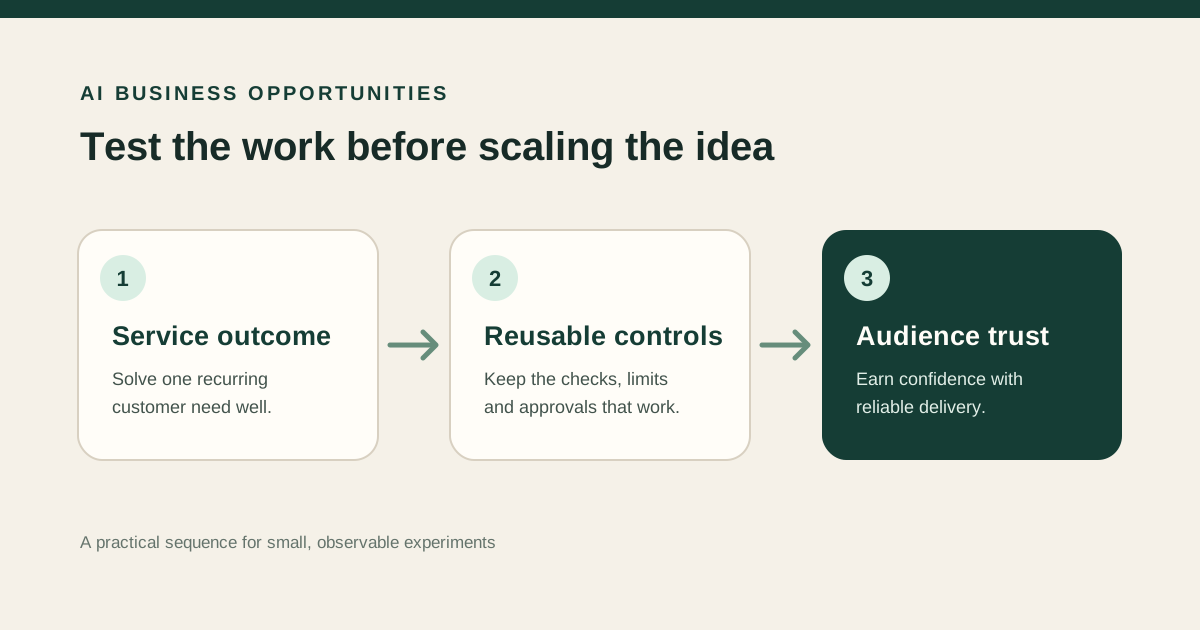
The sequence begins with a service because a completed job gives a customer something concrete to evaluate. Reusable workflow controls come next, followed by an audience with a reason to trust the offer. Each opportunity still needs evidence from its own customers.
1. AI-assisted services with a clear deliverable
Choose a recurring job a customer already understands: preparing a quote, organizing approved information or producing a draft for review. Define the inputs, the finished output and the person responsible for checking it.
Greg uses niche bookkeeping as a service example. A less sensitive, draft-only workflow may be a more practical starting point for an operator without specialist accounting expertise.
Test one job with permissioned inputs. Compare quality, hands-on effort and turnaround against the current process, including time spent fixing errors. A service earns further investment when the customer wants the result again and the delivery process is workable.
2. Reusable systems around the model
A recurring job needs more than a prompt. It needs reliable inputs, tools, permissions, checks and a route for exceptions. Greg calls this surrounding system a domain-specific harness.
The opportunity is to turn lessons from a proven workflow into reusable components. A service firm might reuse intake forms, approval steps and quality checks across similar jobs. A creative business might standardize asset naming and continuity checks while keeping creative decisions with people.
Try a second comparable job before building a platform. Record which steps transfer cleanly and which need custom work. Reuse is useful only when it preserves the quality the customer expects.
3. Niche audiences with a direct relationship
An audience can help a business understand recurring questions and build trust around a specific subject. Greg describes a sequence of audience, community and product. A permission-based email list is one possible addition to that approach.
Choose a narrow topic your intended customer already cares about. Publish a useful series, invite questions and look for evidence that people return or ask for help with the same problem.
Follower totals alone do not establish demand. The useful question is whether the audience and the offer belong together. A focused group asking relevant questions may give you better direction than a large audience with little interest in buying.
4. Useful information that is difficult to replace
A dataset has a business purpose when it helps someone make a better decision. It also needs clear rights, consistent definitions and a way to stay current.
For a local discovery product, useful information could include a specific item, its location, the date observed and a genuine reviewer’s experience. In a service business, permissioned quality and exception records could help identify where a workflow needs improvement.
Test a small collection against a real decision. Can a user choose more confidently or complete the job more accurately? More records will not repair unclear rights, stale information or poor coverage.
5. Offline services with better coordination
A physical service still depends on people who can deliver it. AI may help prepare quote drafts, organize inventory or suggest a schedule, while human judgment handles the customer promise and the work itself.
Greg discusses physical community experiences. Applying that idea to local installation or seasonal services is an extension of his framework, not a business he endorsed for AIBB.
Start with a compact service area and one clear package. Include travel, labor, replacements and storage in the cost. Keep quotes, purchases and commitments behind approval. A busy calendar is useful only if the work can be delivered reliably at a workable cost.
6. Niche physical products with a clear reason to buy
A physical product needs taste, quality and dependable fulfillment. AI can support catalog organization or concept exploration, but the customer will judge the item that arrives.
A small collection around a coherent interest can give an operator a manageable way to test demand. Customer questions may reveal which details matter, from materials and size to packaging and use.
Keep the first test small and examine paid demand before expanding inventory. Count sourcing, shipping, breakage and returns. A compelling image does not establish that the product can be supplied consistently or sold at a sustainable margin.
7. Vertical agents with a bounded job
A vertical agent handles a recurring task in a specific setting. Greg’s restaurant purchasing example includes asking for approval before placing an order.
This belongs after workflow controls in the proposed sequence. The agent performs the job; the surrounding system supplies its permissions, checks and recovery steps. Those controls can improve human-reviewed work before more autonomy is useful.
Begin with recommendations or drafts. Test normal cases and exceptions, including incomplete inputs and incorrect suggestions. Keep consequential actions subject to approval until the responsible people understand the failure modes and can stop or recover the process.
8. Responsible AI implementation as part of a service
Customers need to understand what a workflow can read, what it can change and who approves the result. Helping document those boundaries can be part of a practical implementation service.
Start with a read-and-draft workflow. Identify the data it needs, restrict access, record important actions and test the approval and recovery paths. Involve the customer’s qualified IT or security provider where specialist judgment is required.
This is a proposal to improve implementation quality. It does not establish that an operator has cybersecurity expertise or can guarantee protection. Make responsibilities and limits clear before offering the service.
9. Local communities that may support a marketplace
A useful community can come before a transaction platform. A local discovery service, for example, could first help people find reliable information and contribute fresh observations.
Concentrate on one place or recurring need. Learn whether people return, whether the information stays useful and whether contributors can be supported without an excessive moderation burden.
Consider marketplace features only when users repeatedly need a specific match, booking or order. That evidence matters more than adding transaction tools because marketplaces appear on an opportunity list. Keep paid visibility distinct from independent recommendations.
10. Nonclinical wellbeing and routine support
Routine-building is adjacent to Greg’s health and care category, but it has a different scope from clinical services. A nonclinical product can help adults organize routines they choose, understand their progress and decide whether to involve someone supportive.
Test simple, accessible routine creation with a defined audience. Ask why people return, what they find useful and what causes them to stop.
Avoid promising health outcomes or collecting sensitive information without a clear need. Optional accountability should support a person’s choices. Usage alone does not demonstrate a medical benefit.
Choose one opportunity you can test honestly
Compute, energy, robotics and standalone physical assets remain part of Greg’s wider framework. They require their own capital, operating and specialist diligence. This list gives priority to tests a small operator may be able to define and supervise more directly.
For a first experiment, write down the customer, the recurring job, the permitted inputs, the quality standard and the human approver. Record the current process before comparing an assisted version. Include corrections, exceptions and direct costs in that comparison.
Agree in advance what would justify continuing, revising or stopping. A small test provides operational learning; it does not prove a market or forecast growth.
Choose one job your customer would value having done well. Build the next step around what that test actually shows.
Source note
Adapted from Greg Isenberg’s “13 Businesses for the Age of AI”: https://www.youtube.com/watch?v=bQPU6UJ4iCw
The existing research package reviewed the creator’s chapters and English auto-captions on October 19, 2026. Auto-captions can misrecognize words and names, so this article uses paraphrases. Unverified claims about returns, valuations and productivity are omitted. The ten-item order, practical tests and company applications are editorial interpretations, not Greg’s endorsements or evidence of completed work.
Keep building the system
Recommended next Business Boomer guides
These links are selected by topic and search intent so this guide connects to the most relevant service pages, industry pages, and supporting blog posts.
Service and setup pages
Use these when you are ready to turn the idea into an implementation path.
Industry-specific pages
See how the same workflow changes for specific business types.
Related blog posts
Read the connected guides that support this topic cluster.
Related AI automation guides
Keep going with the connected Business Boomer guides in this automation cluster.
Automatic invoicing setup for business
Map the trigger, template, payment link, reminders, overdue task, and testing for a focused invoicing setup.
AI automation services for local small business
Planning examples for broader automation. Compare current managed calls and reviews on the Services page; confirm other work in a separate scope.
AI automation for local service businesses
Practical lead, scheduling, review, CRM, invoice, and admin automation for plumbers, HVAC companies, roofers, landscapers, cleaners, contractors, and other local operators.
AI assistant for local business
Owner-controlled AI assistants that help local businesses handle missed leads, scheduling handoffs, FAQs, reviews, CRM updates, and follow-up.
FAQ
Quick answers about this guide and how to put the idea into practice.
What is the main takeaway from 10 Business Opportunities to Test in the Age of AI?
A practical response to Greg Isenberg’s thirteen-business framework, focused on manageable tests for small-business operators.
How does AI business opportunities help a small business?
AI business opportunities can help a small business reduce manual work, improve follow-up, organize repetitive tasks, and create a clearer operating process when it is tied to a real bottleneck.
Can Business Boomer help implement AI business opportunities?
Yes. Business Boomer can help turn the idea into a practical workflow, page, checklist, or automation system depending on what the business needs first.
Find the workflow worth fixing first.
Use the Free 30-Minute AI Consultation to map where leads, invoices, notes, or follow-ups are slipping and choose the smallest useful system.
Book a Free 30-Minute AI Consultation