
Best AI Marketing Tools in 2026: The Practical Stack for Growth Teams
The best AI marketing stack in 2026 is not one giant platform. Lean teams should use ChatGPT or Claude for strategy and copy, Perplexity for research, Midjourney or Ideogram for creative exploration, Canva for production, Zapier, Make, or n8n for automation, and Looker Studio for reporting.


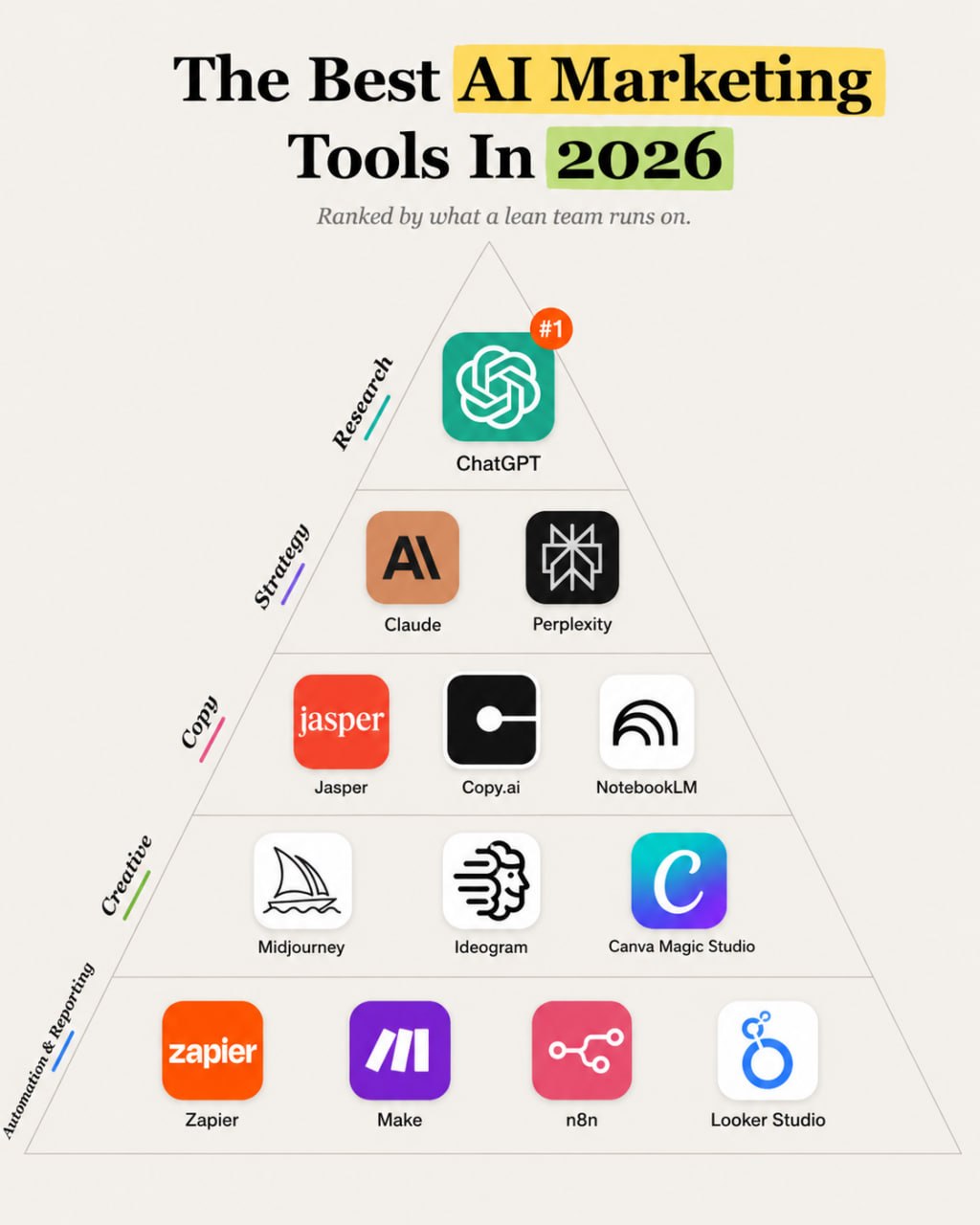
AI marketing tools help with research, positioning, copy, creative production, automation, and reporting. They do not replace the marketing system. If the team has no offer, no audience insight, and no review loop, the tools only make more noise faster.
Quick answer: Most lean teams should start with ChatGPT or Claude, Perplexity, Canva, one automation layer such as Zapier or Make, and Looker Studio. Add Midjourney, Ideogram, Jasper, Copy.ai, NotebookLM, or n8n only when the workflow needs them.
This guide ranks tools by workflow fit, output quality, ease of use, integrations, value, and reliability. Pricing changes often, so check current vendor pricing pages before you buy.
If you are building the broader stack, compare this guide with AI SEO tools, content marketing tools, and startup growth tools.
Quick verdict
| Need | Best first choice |
|---|---|
| Best overall | ChatGPT |
| Best for long-form strategy and editing | Claude |
| Best for research discovery | Perplexity |
| Best for campaign copy systems | Jasper |
| Best for fast creative production | Canva Magic Studio |
| Best specialist creative layer | Midjourney or Ideogram |
| Best automation layer | Zapier, Make, or n8n |
| Best reporting layer | Looker Studio |
Best tools at a glance
| Tool | Best for | Category | Starting price | Key strength | Main limitation |
|---|---|---|---|---|---|
| ChatGPT | research synthesis, strategy, briefs, copy, repurposing | AI assistant | Free and paid plans | Flexible across marketing jobs | Needs clear inputs and review |
| Claude | long-form messaging, editing, and campaign review | AI assistant | Free and paid plans | Strong long-context editorial work | Not a reporting or asset-production platform |
| Perplexity | source discovery and market scans | Research | Free and paid plans | Fast source-oriented research paths | Official sources still need manual verification |
| Jasper | brand-controlled marketing copy workflows | Copy platform | Paid plans | Useful templates and brand controls | Can overlap with ChatGPT and Claude |
| Copy.ai | go-to-market copy and workflow prompts | Copy platform | Free and paid plans | Good for repeatable GTM writing jobs | Less necessary if the team already has a strong AI workflow |
| NotebookLM | turning source docs into campaign context | Research workspace | Free core product | Grounds work in uploaded material | Only as good as the source library |
| Midjourney | high-quality visual concepts | AI image generation | Paid plans | Strong visual exploration | Copyright and brand-review risk require care |
| Ideogram | marketing visuals and typography-aware concepts | AI image generation | Free and paid plans | Useful for concepting ads and social visuals | Do not rely on AI text for final assets |
| Canva Magic Studio | production-ready social and campaign assets | Creative production | Free and paid plans | Fast for non-designers | Less precise than dedicated design systems |
| Zapier | simple marketing automations | Automation | Free and paid plans | Broad app coverage | Can become expensive or brittle at scale |
| Make | visual multi-step workflows | Automation | Free and paid plans | Good balance of power and accessibility | Needs workflow ownership |
| n8n | technical owned automation | Automation | Free self-hosted and paid cloud options | More control and self-hosting options | Higher setup burden |
| Looker Studio | dashboards and reporting | Analytics | Free core product | Good reporting layer for Google-heavy stacks | Data quality depends on setup |
How we evaluated the tools
We evaluated each tool as part of a real operating workflow, not as an isolated feature list.
| Criterion | Weight |
|---|---|
| Use-case fit | 25% |
| Capability and output quality | 20% |
| Ease of use | 15% |
| Integrations and workflow fit | 15% |
| Price-to-value | 15% |
| Scalability and reliability | 10% |
A complete platform can own several workflow layers. A specialist tool should earn its place by solving one painful job better than the default stack. Supporting tools belong lower in the stack unless the workflow depends on them every week.
The best ai marketing tools in 2026
ChatGPT: Best for best default AI marketing assistant
Use ChatGPT for campaign briefs, customer research synthesis, ad angles, landing page drafts, email variants, content repurposing, and reporting summaries. It made the list because lean teams need one flexible thinking and drafting layer before they buy specialized platforms. Choose it when you have source material, examples, and a clear reviewer. Avoid using it as an unsupervised publisher. Closest alternative: Claude.
Key capabilities usually include setup, workflow ownership, integrations, review, and reporting. The best choice depends on team size, existing stack, data quality, and budget.
Claude: Best for best long-form strategy and editorial review
Claude fits teams that need sharper campaign narratives, positioning cleanup, launch copy review, and long-form content editing. It is useful when the team already has notes, interviews, transcripts, or article drafts. Choose it for depth and clarity. Avoid it when the bottleneck is visual production or automation. Closest alternative: ChatGPT.
Key capabilities usually include setup, workflow ownership, integrations, review, and reporting. The best choice depends on team size, existing stack, data quality, and budget.
Perplexity: Best for best research discovery layer
Perplexity helps marketers find sources, scan current conversations, compare category pages, and build a research path. Use it early, then verify product facts with official pages and primary sources. It made the list because fast-moving AI marketing categories go stale quickly. Avoid citing its summary when a primary source exists. Closest alternative: manual search plus source review.
Key capabilities usually include setup, workflow ownership, integrations, review, and reporting. The best choice depends on team size, existing stack, data quality, and budget.
Jasper: Best for best structured copy platform for marketing teams
Jasper fits teams that want brand voice controls, campaign templates, and repeatable copy workflows for blogs, ads, emails, and social. It is stronger as a managed marketing copy environment than as a general intelligence layer. Choose it when several marketers need consistency. Avoid it if ChatGPT or Claude plus a tight brief already covers the job. Closest alternative: Copy.ai.
Key capabilities usually include setup, workflow ownership, integrations, review, and reporting. The best choice depends on team size, existing stack, data quality, and budget.
Copy.ai: Best for best GTM workflow copy assistant
Copy.ai is useful for outbound, lifecycle, website, and campaign copy workflows. It can help teams turn messaging into repeatable assets. Choose it when the team wants more structured GTM workflows. Avoid it when the team only needs occasional drafts. Closest alternative: Jasper.
Key capabilities usually include setup, workflow ownership, integrations, review, and reporting. The best choice depends on team size, existing stack, data quality, and budget.
NotebookLM: Best for best source-grounded campaign workspace
NotebookLM works when a team has docs, interview notes, product pages, sales calls, or research PDFs and wants a more grounded campaign workspace. Choose it for synthesis from known material. Avoid it when the team has no source library. Closest alternative: Perplexity for external discovery.
Key capabilities usually include setup, workflow ownership, integrations, review, and reporting. The best choice depends on team size, existing stack, data quality, and budget.
Midjourney and Ideogram: Best for best AI creative concepting layer
Midjourney and Ideogram help teams explore visual directions for ads, social posts, and campaign concepts. Use them for mood, composition, and rough creative routes, then rebuild final branded assets with a designer or deterministic layout. Do not generate fake logos, fake screenshots, or final legal-sensitive claims. Closest alternative: Canva Magic Studio.
Key capabilities usually include setup, workflow ownership, integrations, review, and reporting. The best choice depends on team size, existing stack, data quality, and budget.
Canva Magic Studio: Best for best practical creative production tool
Canva turns campaign ideas into social graphics, presentations, thumbnails, simple video assets, and brand-kit templates. Choose it when non-designers need to ship. Avoid it when the project needs a strict design system or complex product UI work. Closest alternative: Figma.
Key capabilities usually include setup, workflow ownership, integrations, review, and reporting. The best choice depends on team size, existing stack, data quality, and budget.
Zapier, Make, and n8n: Best for best marketing automation layer
Zapier is the easiest first automation layer, Make gives visual workflow control, and n8n gives technical teams more ownership. Use one of them to move leads, trigger briefs, route form fills, sync CRM fields, and send reporting alerts. Avoid overlapping all three unless the team has a clear reason. Closest alternative: native automations inside your CRM.
Key capabilities usually include setup, workflow ownership, integrations, review, and reporting. The best choice depends on team size, existing stack, data quality, and budget.
Looker Studio: Best for best lightweight reporting layer
Looker Studio is useful for pulling Google Ads, GA4, Search Console, Sheets, and connector data into stakeholder dashboards. Choose it when the team needs a shared view of campaign performance. Avoid pretending a dashboard fixes tracking gaps. Closest alternative: built-in platform reporting or a paid BI tool.
Key capabilities usually include setup, workflow ownership, integrations, review, and reporting. The best choice depends on team size, existing stack, data quality, and budget.
Recommended stacks by team type
Solo operator
Use ChatGPT, Perplexity, Canva, Zapier, Looker Studio. This keeps the stack focused while giving each workflow layer a clear owner.
Lean startup
Use Claude or ChatGPT, NotebookLM, Canva, Make, GA4, Search Console. This keeps the stack focused while giving each workflow layer a clear owner.
Agency
Use Jasper or Copy.ai, Canva, Make, Looker Studio, client-specific ad and CRM tools. This keeps the stack focused while giving each workflow layer a clear owner.
Technical team
Use ChatGPT, n8n, Looker Studio, warehouse or product analytics data. This keeps the stack focused while giving each workflow layer a clear owner.
Brand-heavy team
Use Claude, Midjourney or Ideogram for concepts, Canva or Figma for final assets. This keeps the stack focused while giving each workflow layer a clear owner.
How to choose the right tool
Start with the workflow. A small team should not buy a platform because it looks impressive in a comparison table. Ask what job breaks today: research, creative production, conversion, analytics, lifecycle, support, automation, or reporting.
Team size matters. A solo operator needs fewer tools and more defaults. A startup with engineers can handle deeper instrumentation. An agency needs repeatable workflows across clients. A mid-market team needs governance, permissions, and reporting.
Budget matters too. Free and entry-level plans can cover early workflows, but paid plans become worthwhile when the tool saves labor, reduces mistakes, or improves decisions. Switching costs rise when tools hold customer data, content libraries, automations, analytics events, or payment history.
Check integrations before buying. A tool that does not connect to your CRM, website, analytics, email platform, or data warehouse may create another manual process. Also check data ownership, export options, security posture, and approval controls before connecting sensitive workflows.
Tools we considered but did not rank
- HubSpot AI because it belongs inside the CRM stack for many teams.
- Adobe Firefly because it is stronger in design workflows than general marketing operations.
- Writer because it skews enterprise.
- Anyword because it is narrower than the default stack for most lean teams.
Final recommendation
Use ChatGPT or Claude as the brain, Perplexity or NotebookLM as the research layer, Canva as the production layer, one automation tool, and Looker Studio for reporting. Add Jasper, Copy.ai, Midjourney, Ideogram, Make, or n8n only when the workflow proves the need.
The right stack should make the workflow easier to run next week. If a tool creates more meetings, more dashboards, or more cleanup than decisions, it belongs on the waitlist.
Sources to check before purchase
- Official product websites and pricing pages for the tools above
- Current documentation for integrations, data handling, API access, and usage limits
- Recent customer reviews on G2, Capterra, Trustpilot, Reddit, or category-specific communities
Ready to build a practical AI growth stack?
AI Business Boomer helps lean teams turn scattered tools into working systems. Book a workflow audit and we will map the stack around your actual bottleneck.
Keep building the system
Recommended next Business Boomer guides
These links are selected by topic and search intent so this guide connects to the most relevant service pages, industry pages, and supporting blog posts.
Service and setup pages
Use these when you are ready to turn the idea into an implementation path.
Industry-specific pages
See how the same workflow changes for specific business types.
Related blog posts
Read the connected guides that support this topic cluster.
Related AI automation guides
Keep going with the connected Business Boomer guides in this automation cluster.
Best invoicing automation tools for small business
A comparison of QuickBooks, FreshBooks, Stripe Billing, Wave, Jobber, Housecall Pro, Zapier, and Make.
Best AI automations for contractors
Field notes, estimate follow-up, scheduling, internal handoffs, and admin workflows.
AI automation services for local small business
Planning examples for broader automation. Compare current managed calls and reviews on the Services page; confirm other work in a separate scope.
AI automation for local service businesses
Practical lead, scheduling, review, CRM, invoice, and admin automation for plumbers, HVAC companies, roofers, landscapers, cleaners, contractors, and other local operators.
FAQ
Quick answers about this guide and how to put the idea into practice.
What is the best AI marketing tool in 2026?
For most lean teams, ChatGPT is the best default because it supports research, strategy, copy, repurposing, and analysis. Pair it with Canva, one automation tool, and a reporting layer.
Do AI marketing tools replace marketers?
No. They speed up research, drafting, creative exploration, automation, and reporting. Marketers still own positioning, source checks, judgment, approvals, and performance review.
Should I use Jasper or ChatGPT?
Use ChatGPT for flexibility. Use Jasper when a team needs more structured brand controls, repeatable marketing templates, and campaign workflows.
What is the biggest risk with AI marketing tools?
The main risk is publishing generic or inaccurate work at scale. Copyright, brand safety, privacy, and attribution also need review.
What should a lean AI marketing stack include?
Start with ChatGPT or Claude, Perplexity or NotebookLM, Canva, Zapier or Make, and Looker Studio.
Find the workflow worth fixing first.
Use the Free 30-Minute AI Consultation to map where leads, reviews, content, or follow-ups are slipping and choose the smallest useful next step.
Book a Free 30-Minute AI Consultation