
AI Automation Agency for Service Businesses
A good AI automation agency for a service business should map one real bottleneck, build a working workflow, document the handoff, and leave the owner with a system the team can run.


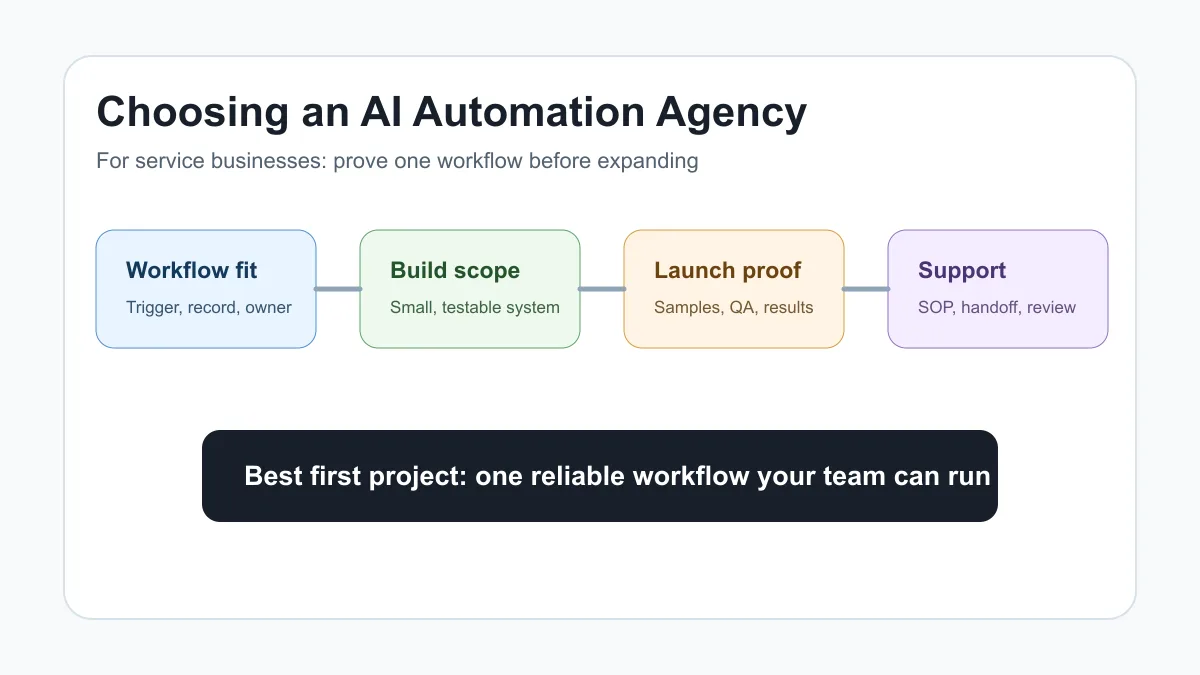
An AI automation agency for service businesses should help you turn a real operational bottleneck into a working system. The right partner does not start with a flashy demo. They identify one workflow, connect the tools that already matter, add AI only where it helps, test the handoff, and document how your team should use it.
For most small service businesses, the best first agency project is one practical workflow: lead follow-up, estimate follow-up, intake, scheduling, invoice reminders, customer updates, reporting, or owner admin capture. Choose an agency by how clearly they can scope, build, test, and support that first workflow.
Search intent and top-result pattern
People searching this topic are usually comparing agencies, deciding whether outside help is worth it, or trying to avoid hiring someone who only resells generic automation tools. Current U.S. results lean toward ranked agency lists, broad service comparison posts, and how-to-choose guides. Common advice includes checking case studies, pricing, technical ability, and whether the agency understands the buyer's industry.
The gap for a service-business owner is practical: what the agency should build first, what proof to ask for, and how to tell the difference between a useful implementation partner and a vendor selling vague AI strategy.
If you are still comparing the broad service category, start with AI automation services for small business. This article assumes you are already considering outside help and need a better way to choose.
Start with the bottleneck, not the agency pitch
Before you evaluate an agency, write down the workflow that is currently costing time, speed, or consistency. A service business usually has one obvious candidate: new leads wait too long, estimates are not followed up, appointment reminders are inconsistent, invoices go out late, or customer notes stay scattered across inboxes and phones.
A good agency should be comfortable narrowing the first project. If the sales call immediately jumps to "AI agents for everything," custom dashboards, and multi-month transformation language, ask them to reduce the scope to one workflow that can be tested with real examples.
Business Boomer's AI automation services use this same logic: pick the painful handoff first, build the minimum reliable system, then expand after the business sees what works.
What a useful agency should be able to explain
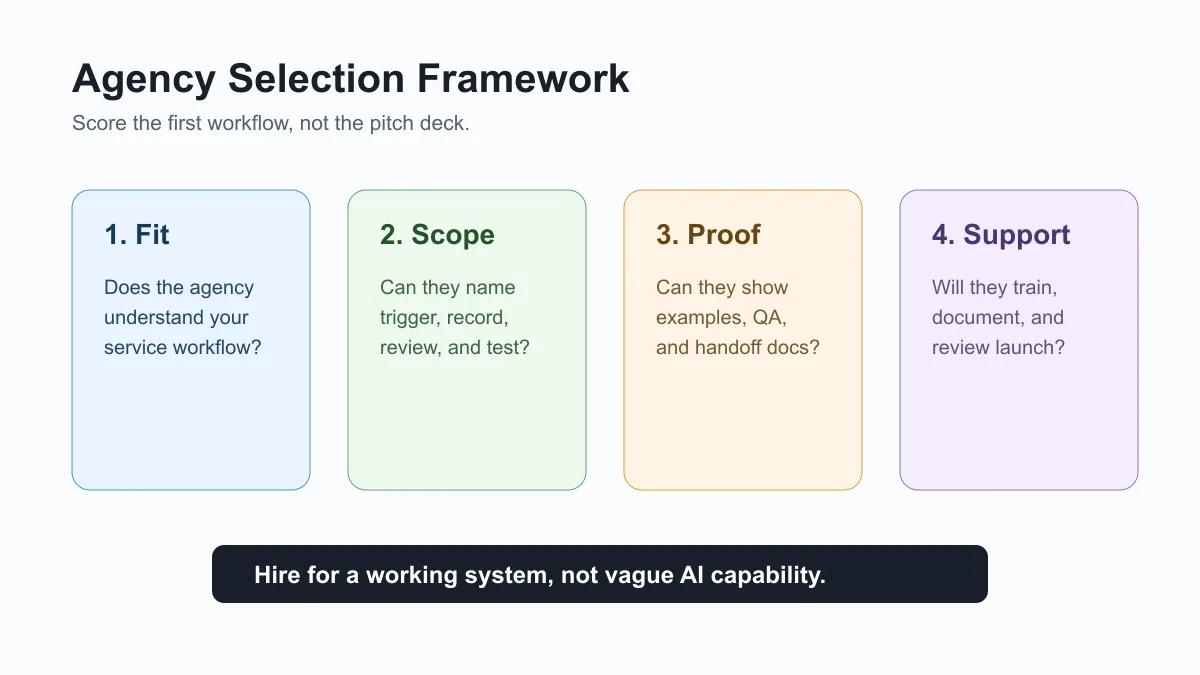
The agency should be able to explain the project in plain English. You should understand what starts the workflow, where information goes, what AI is allowed to do, where a human approves the output, and how exceptions are handled.
For example, a lead follow-up workflow might start from a website form, summarize the inquiry, create a CRM record, draft a response, notify the owner for urgent requests, and create a follow-up task if no appointment is booked. That is much more concrete than "we will automate your sales process."
If the provider cannot describe the trigger, source of truth, human review point, and success measure, compare their plan against AI workflow automation for small business before signing. A vague workflow is hard to test and harder to maintain.
| What to ask | Strong answer | Weak answer |
|---|---|---|
| What workflow comes first? | One named process with a clear trigger | "We will automate operations" |
| What tool owns the record? | CRM, job tool, inbox, spreadsheet, or accounting system | "The AI will handle it" |
| Where does human review happen? | Named approval step for sensitive outputs | "AI can do it automatically" |
| How will we test it? | Sample records, one real low-risk run, and launch checklist | "It should work after setup" |
| What do we receive? | Workflow map, configuration notes, SOP, and handoff call | Login credentials and a quick demo |
Look for service-business fit
Service businesses run on trust, timing, and handoffs. A law firm intake process, real estate lead workflow, contractor estimate follow-up, med spa appointment reminder, and home services billing process all need different guardrails.
An agency does not need to specialize in your exact trade, but it should understand service operations. Ask how they would handle urgent leads, no-shows, job notes, quote approvals, customer objections, payment follow-up, and staff review. Those details reveal whether they understand your business model or only know the automation tool.
If you operate across several service lines, use the industries guide to identify which workflow should be tailored by vertical. The first build for a contractor may focus on estimates and job completion. The first build for a professional service firm may focus on intake, scheduling, and follow-up notes.
Separate tool setup from implementation
Many agencies can connect Zapier, Make, Airtable, HubSpot, GoHighLevel, QuickBooks, Jobber, Housecall Pro, Google Workspace, or an AI model. That is useful, but tool connection is not the whole project.
Implementation means the workflow matches how the business works. It includes field choices, naming rules, duplicate handling, reminder timing, approval points, fallback steps, reporting, and documentation. Without those details, the business gets another tool stack instead of a working system.
The distinction matters most when AI is involved. The guide to AI vs automation for small business owners is a good guardrail here: rules should move predictable work, while AI should help with messy text, summaries, classification, drafts, and review support.
Ask for proof without accepting fake certainty
Proof matters, but be careful with exaggerated claims. A trustworthy agency can show relevant examples, explain what was built, describe what stayed manual, and tell you how the workflow was tested. They do not need to promise guaranteed revenue, guaranteed savings, or guaranteed rankings to prove they can help.
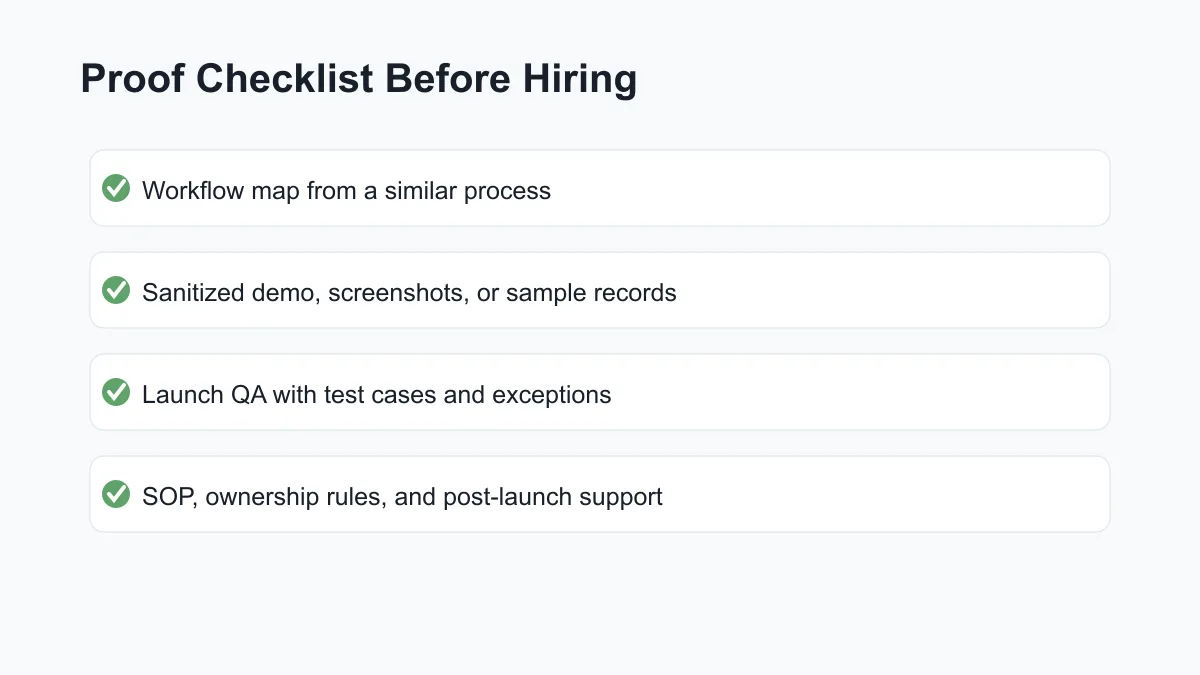
Ask for proof in practical terms:
- a workflow map from a similar project
- screenshots or a sanitized demo
- examples of prompts, templates, or SOPs
- launch checklist and test records
- explanation of what went wrong during testing
- references or named results when available
The U.S. Small Business Administration's AI for small business guidance is a useful reminder to understand risks and responsibilities before adopting AI. For service businesses, that means keeping people involved where pricing, legal language, medical details, refunds, or trust-sensitive customer communication are involved.
Scope the first project tightly
A first project should be small enough to launch, test, and improve without disrupting the whole business. A useful scope might say: "When a new quote form arrives, create a CRM record, summarize the request, assign urgency, send an acknowledgment, notify the owner for high-intent leads, and create a follow-up task after two business days."
That scope has a trigger, record, AI task, customer message, owner alert, and follow-up rule. It can be tested. It also leaves room for human judgment.
For lead-heavy businesses, compare the agency's proposed scope with how to build an AI automation workflow for lead follow-up. If the proposal cannot name the lead source, response rule, review point, and measurement plan, it is probably not ready.
Watch the pricing conversation
Pricing should reflect the workflow, not the word "AI." Some projects are simple tool setup. Others involve several systems, custom logic, customer-facing messages, staff training, and post-launch support.
Ask what is included in the price: discovery, workflow mapping, tool configuration, AI prompts, templates, testing, documentation, launch support, and revisions. Also ask what is not included, such as paid software subscriptions, API usage, ongoing maintenance, new workflows, or staff training beyond the first handoff.
A practical agency should be able to break the work into phases. For many small businesses, phase one should prove one workflow before the owner pays for a broader operating system.
Red flags when choosing an AI automation agency
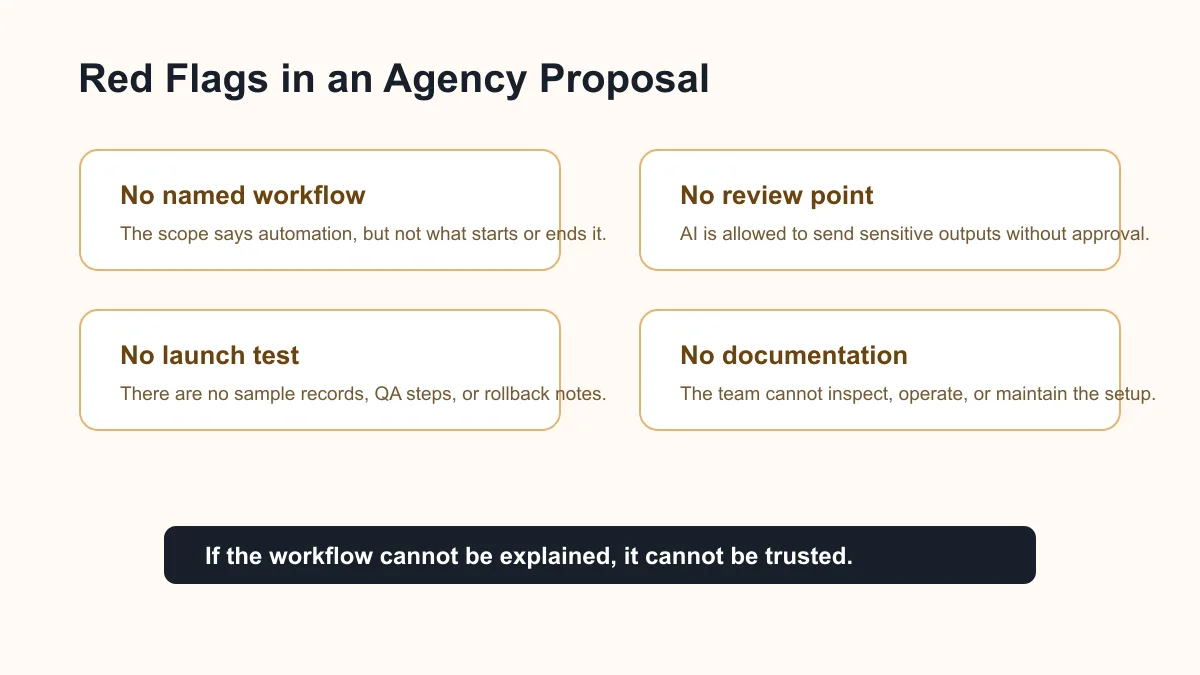
Be careful if an agency refuses to define the first workflow, promises autonomous operations without review, cannot explain the tools, avoids testing details, or only talks about AI models instead of business outcomes.
Other red flags include no documentation, no rollback plan, no exception handling, no discussion of customer data, no ownership of launch support, and no willingness to work inside the tools your team already uses. The business should not become dependent on a mystery setup nobody can inspect.
If the conversation feels like consulting without implementation, compare it with AI automation consulting for small business. Consulting can be useful, but the deliverable should still move toward a workflow your team can run.
What the agency should deliver
At minimum, expect a workflow map, tool configuration notes, message templates, AI prompt instructions where relevant, test evidence, and an SOP for the person who owns the workflow. For a lead system, that might include example records, routing rules, response templates, follow-up timing, and a weekly review checklist.
For a billing workflow, the deliverables should include trigger rules, invoice template notes, reminder language, payment status checks, exception handling, and an owner dashboard. If billing is the first bottleneck, the invoice automation setup page is the more focused buying path.
Ask the agency to explain how your team will know the workflow is healthy. A good answer includes a small set of checks: records created, messages drafted or sent, stuck items, errors, exceptions, and owner tasks waiting for action.
Example: choosing an agency for a home service business
Imagine a home service company that gets quote requests from a website form, phone calls, and referrals. The owner wants faster response without losing control over pricing.
The right first project might capture website form leads, summarize the request, create or update a CRM record, send a short acknowledgment, alert the owner for urgent jobs, and create a follow-up task if the lead has not booked. Phone transcripts and referral tracking can come after the first workflow works.
This kind of business may later add invoice reminders, review requests, scheduling reminders, or internal job summaries. Judge the first agency decision by whether they can make one lead handoff reliable.
Example: choosing an agency for a professional service firm
A professional service firm may need more review and less automatic sending. Intake notes, client summaries, appointment preparation, proposal follow-up, and document routing can all benefit from AI, but sensitive client communication should stay controlled.
The first project might summarize intake forms, flag missing details, create a draft follow-up, and prepare an internal briefing before a consultation. The agency should explain what data is used, who reviews the draft, and how sensitive information is handled.
If the firm wants a broader internal assistant after the first workflow is stable, OpenClaw onboarding can support recurring task capture, owner notes, and operating reviews without pretending every customer-facing decision should be automatic.
Questions to ask before hiring
Use these questions before approving the project:
- What exact workflow are you building first?
- What event starts the workflow?
- Which system owns the customer or job record?
- What will AI summarize, classify, draft, or decide?
- Which outputs need human approval?
- What examples will you test before launch?
- What happens when the automation fails or receives incomplete information?
- What documentation and training will my team receive?
- What is included after launch?
- What would you recommend not automating yet?
The last question is important. A serious agency should be able to name boundaries.
How Business Boomer would approach the first build
For most service businesses, Business Boomer would start with a Free 30-Minute AI Consultation, choose one workflow close to revenue or owner time, and build the smallest reliable system around it. That usually means lead follow-up, estimate follow-up, invoice reminders, intake, scheduling, or owner admin capture.
The first workflow should make the work easier to run. If it saves the owner from chasing notes, remembering follow-ups, or manually checking the same dashboard every day, the agency has created a useful foundation.
If you want help deciding which workflow should come first, book a Free 30-Minute AI Consultation. Bring one messy process, the tools you already use, and a few real examples. That is enough to decide whether an AI automation agency is worth hiring for the first build.
If the first build is website-to-lead follow-up, connect the agency scope to AI website for service businesses.
Next step
Find the workflow worth fixing first.
Use the Free 30-Minute AI Consultation to map where leads, invoices, notes, or follow-ups are slipping and choose the smallest useful system.
Keep building the system
Recommended next Business Boomer guides
These links are selected by topic and search intent so this guide connects to the most relevant service pages, industry pages, and supporting blog posts.
Service and setup pages
Use these when you are ready to turn the idea into an implementation path.
Industry-specific pages
See how the same workflow changes for specific business types.
Related blog posts
Read the connected guides that support this topic cluster.
Related AI automation guides
Keep going with the connected Business Boomer guides in this automation cluster.
AI automation services for local small business
Planning examples for broader automation. Compare current managed calls and reviews on the Services page; confirm other work in a separate scope.
AI automation for local service businesses
Practical lead, scheduling, review, CRM, invoice, and admin automation for plumbers, HVAC companies, roofers, landscapers, cleaners, contractors, and other local operators.
AI website for service businesses
Clearer service pages, lead paths, FAQs, reviews, and AI-assisted follow-up for service businesses.
Review request automation
Timely review requests, owner-approved review replies, and private service-recovery tasks after completed work.
FAQ
Quick answers about this guide and how to put the idea into practice.
What is the main takeaway from AI Automation Agency for Service Businesses?
A good AI automation agency for a service business should map one real bottleneck, build a working workflow, document the handoff, and leave the owner with a system the team can run.
How does AI automation agency for service businesses help a small business?
AI automation agency for service businesses can help a small business reduce manual work, improve follow-up, organize repetitive tasks, and create a clearer operating process when it is tied to a real bottleneck.
Can Business Boomer help implement AI automation agency for service businesses?
Yes. Business Boomer can help turn the idea into a practical workflow, page, checklist, or automation system depending on what the business needs first.
Find the workflow worth fixing first.
Use the Free 30-Minute AI Consultation to map where leads, invoices, notes, or follow-ups are slipping and choose the smallest useful system.
Book a Free 30-Minute AI Consultation