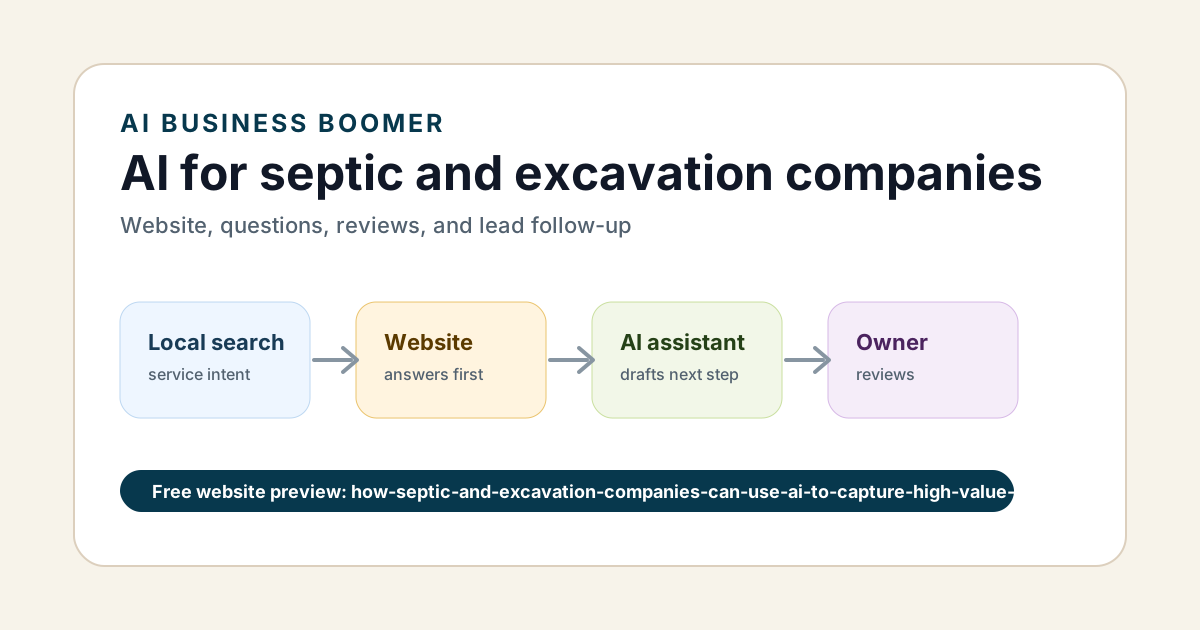
An illustrative, owner-reviewed AI workflow for septic and excavation companies: An excavation or septic request may require site access and an on-site review before the company can determine fit. Clear intake prevents an incomplete request from looking like a confirmed estimate.
AI for carpenters works best when it helps a local carpentry business respond faster, explain services clearly, manage reviews, and follow up with leads without replacing owner judgment.
An illustrative, owner-reviewed AI workflow for masonry and hardscaping companies: Outdoor project inquiries often need dimensions, access information, and a site visit before a reliable estimate is possible. The first reply should collect, not guess, those details.
AI for flooring companies works best when it helps a local flooring company respond faster, explain services clearly, manage reviews, and follow up with leads without replacing owner judgment.
An illustrative, owner-reviewed AI workflow for power-washing companies: A quote for a driveway differs from one for siding or a deck. Photos and material details can help the estimator ask better questions, but they do not establish a final price.
An illustrative, owner-reviewed AI workflow for painting companies: Painting estimates depend on surfaces, preparation, access, and the amount of work. Collecting those details can make an estimator’s next conversation more focused.
Phoenix Alix has spent years trying to understand TMJ. Now she is using AI agents to turn that lived experience into a website, community, and service business.
An illustrative, owner-reviewed AI workflow for hair salons: A salon inquiry often depends on the service length and the stylist’s availability. Color questions may also need a consultation before the team can confirm timing or price.
Compare drafting, SEO research and managed publishing, then use a worked example and a downloadable brief to build a useful small-business blog workflow.
An illustrative, owner-reviewed AI workflow for handyman businesses: Small repair requests can arrive in separate texts and photos, making it hard to see which tasks belong in one visit. A concise job list can help the owner decide what fits.
The best AI website builder for a small business depends on the job: Wix for flexible business sites, Squarespace for polished service brands, Hostinger for budget launches, Shopify for ecommerce, and Webflow or Framer for more design control.
The best AI automation platform for a small business depends on the workflow: Zapier for simple app connections, Make for visual logic, HubSpot for CRM follow-up, and n8n or Pipedream for technical control.
Behind the guides: our publishing process and search data
Inside our publishing process
How we’re building a more useful blog with AI.
See our actual search growth, the pages behind it, and the structure we use to research, refresh, review and publish. Then adapt our skills and automation prompts to your own business.
Same blog cohort, compared per day. September covers 14 days; July and August each cover 31.
Average daily impressions · scale 0–500
July126.7
August169.5
September 1–14partial461.7
July → August: +33.7% impressions over two full months. September’s observed daily rate is 2.72× August’s, not a full-month result or forecast.
Source: Search Console daily table, read September 16, 2026. Web search; pages containing aibusinessboomer.io/blog/. Dates use Pacific Time. Filtered data can be partial. These are search appearances and clicks, not ChatGPT referrals, leads or revenue.
Questions about the AI automation guides and how to use them
What topics does the Business Boomer blog cover?+
The blog covers AI automation, small-business workflows, invoice automation, lead follow-up, industry use cases, OpenClaw setup, and practical ways business owners can use AI.
How should I use these AI automation guides?+
Use each guide to identify one process to improve, then continue to the relevant service, checklist, calculator, or consultation if you want help implementing it.
Are these articles for technical teams or business owners?+
They are written mainly for business owners and operators who care about saving time, improving follow-up, and building practical systems rather than studying AI theory.