An illustrative, owner-reviewed AI workflow for tree service companies: Tree-work requests can involve storm damage, pruning, removal, or stump work, with different access and safety considerations. Route hazard reports to a person without diagnosing from photos.
An illustrative, owner-reviewed AI workflow for HVAC companies: A no-heat call, a maintenance request, and an installation inquiry need different next steps. Intake can help staff see what the caller reported without attempting a diagnosis.
An illustrative, owner-reviewed AI workflow for electrical contractors: Electrical inquiries need careful routing because a caller may describe anything from a fixture request to an urgent power problem. Intake should record the caller’s words and route concerns under a human-approved policy.
An illustrative, owner-reviewed AI workflow for plumbing companies: A leak, a drain problem, and a planned water-heater replacement call for different follow-up. Intake should preserve the caller’s description and follow the company’s human escalation rules.
The best way to use AI in your small business is to choose one repeated workflow, let AI prepare the next step, and keep a person responsible for review. Start with leads, scheduling, billing, customer service, admin notes, or weekly reporting before you try to automate the whole company.
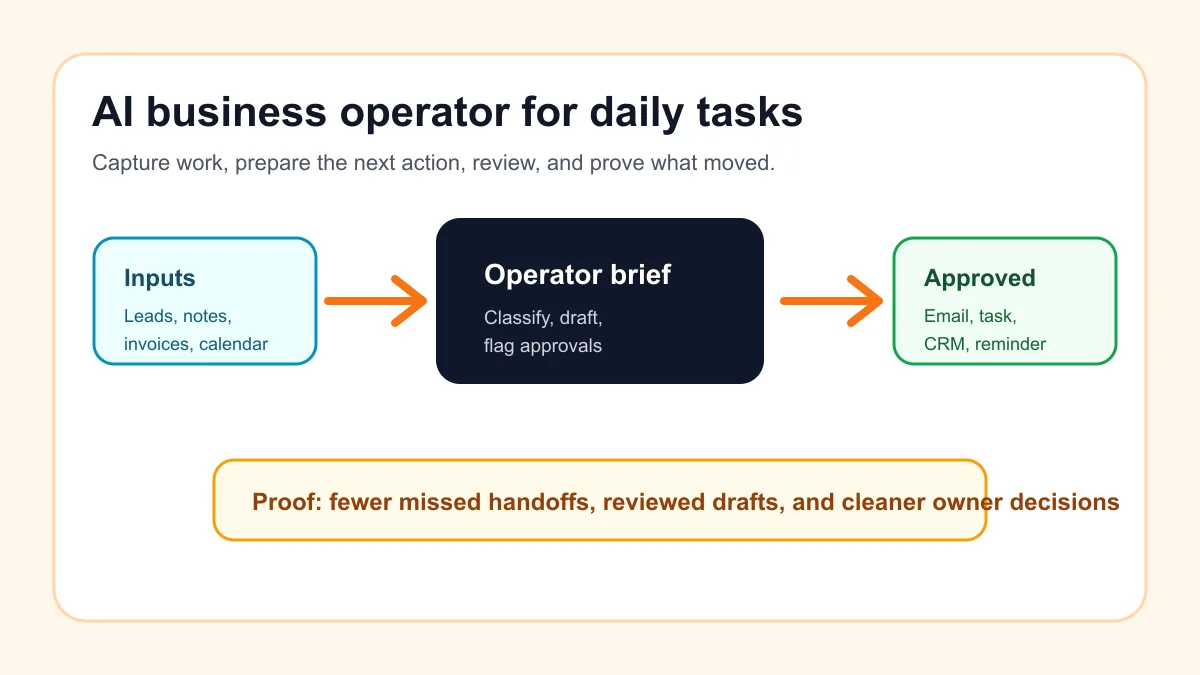
An AI business operator is most useful when it helps capture tasks, prepare drafts, surface follow-ups, and keep a human in control of daily decisions.
Small businesses need AI systems to stay competitive because customers, competitors, and teams now expect faster response, cleaner follow-up, better information, and fewer dropped handoffs. A reviewed operating system around repeated work gives the business the advantage.
The best AI automation partner for a small business is the provider that can turn one real workflow into a tested, documented system your team can run.
AI automation for home service businesses works best when it fixes the path from new lead to booked job, completed work, paid invoice, and follow-up task.
The best AI automation tool stack for a small business is usually the simplest one that moves one real workflow from trigger to review. Overbuilt systems add dashboards, agents, and integrations before the business has a clean process.
The AI automation trends that matter most for small businesses in 2026 point to reviewed workflows, task routing, vertical tools, voice-to-action capture, AI search visibility, and safer systems around leads, billing, and owner admin.
Behind the guides: our publishing process and search data
Inside our publishing process
How we’re building a more useful blog with AI.
See our actual search growth, the pages behind it, and the structure we use to research, refresh, review and publish. Then adapt our skills and automation prompts to your own business.
Same blog cohort, compared per day. September covers 14 days; July and August each cover 31.
Average daily impressions · scale 0–500
July126.7
August169.5
September 1–14partial461.7
July → August: +33.7% impressions over two full months. September’s observed daily rate is 2.72× August’s, not a full-month result or forecast.
Source: Search Console daily table, read September 16, 2026. Web search; pages containing aibusinessboomer.io/blog/. Dates use Pacific Time. Filtered data can be partial. These are search appearances and clicks, not ChatGPT referrals, leads or revenue.
Questions about the AI automation guides and how to use them
What topics does the Business Boomer blog cover?+
The blog covers AI automation, small-business workflows, invoice automation, lead follow-up, industry use cases, OpenClaw setup, and practical ways business owners can use AI.
How should I use these AI automation guides?+
Use each guide to identify one process to improve, then continue to the relevant service, checklist, calculator, or consultation if you want help implementing it.
Are these articles for technical teams or business owners?+
They are written mainly for business owners and operators who care about saving time, improving follow-up, and building practical systems rather than studying AI theory.